Order of the Black Eagle
| Order of the Black Eagle Schwarzer Adlerorden | |
|---|---|
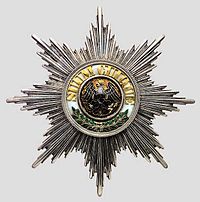 Star of the Order of the Black Eagle | |
| Type | State Order (formerly) House Order (currently) |
| Established | 17 January 1701 |
| Country |  Kingdom of Prussia Kingdom of Prussia |
| Royal house | House of Hohenzollern |
| Motto | Suum Cuique (idiomatically, "to each according to his merits") |
| Eligibility | Members of ruling houses, senior civil and military officials and other worthy figures appointed by the King of Prussia. |
| Awarded for | Civil or military merit |
| Grand Master | Georg Friedrich, Prince of Prussia |
| Grades | Knight |
| Statistics | |
| First induction | 1701 |
| Total inductees | 407 (to 1918)[1] |
| Precedence | |
| Next (higher) | None |
| Next (lower) | Order of the Red Eagle |
 Ribbon of the order | |
The Order of the Black Eagle (German: Hoher Orden vom Schwarzen Adler) was the highest order of chivalry in the Kingdom of Prussia. The order was founded on 17 January 1701 by Elector Friedrich III of Brandenburg (who became Friedrich I, King in Prussia, the following day). In his Dutch exile after World War I, deposed Emperor Wilhelm II continued to award the order to his family. He made his second wife, Princess Hermine Reuss of Greiz, a Lady in the Order of the Black Eagle.
Contents
1 Overview
2 Insignia
3 Membership
4 Sovereigns and Masters of the Order
5 Recipients
5.1 Royal House of Hohenzollern
5.2 Princely House of Hohenzollern
5.3 Foreign royal members of the Order
5.4 Knights of the Order
6 Current usage
7 Notes
8 References
9 External links
Overview
The statutes of the order were published on 18 January 1701, and revised in 1847. Membership in the Order of the Black Eagle was limited to a small number of knights, and was divided into two classes: members of reigning houses (further divided into members of the House of Hohenzollern and members of other houses, both German and foreign) and capitular knights. Before 1847, membership was limited to nobles, but after that date, capitular knights who were not nobles were raised to the nobility (Adelsstand).[2] Capitular knights were generally high-ranking government officials or military officers.
The Order of the Black Eagle had only one class, but could also be awarded at the king's prerogative "with the Chain" ("mit der Kette") or without ("ohne Kette"). By statute, members of the order also held the Grand Cross of the Order of the Red Eagle, and wore the badge of that order from a ribbon around the neck. From 1862, members of the Prussian royal house, upon award of the Order of the Black Eagle, also received the Prussian Crown Order 1st Class.[3]
Insignia

Badge of the Order of the Black Eagle.
The badge of the Order was a gold Maltese cross, enameled in blue, with gold-crowned black eagles between the arms of the cross. The gold center medallion bore the royal monogram of Friedrich I ("FR", for Fredericus Rex).
This badge was worn from either a broad ribbon (or sash) or a collar (or "chain"). The ribbon of the Order was an orange moiré sash worn from the left shoulder to the right hip, with the badge resting on the hip. The sash color was chosen in honor of Louise Henriette of Nassau, daughter of the prince of Orange and first wife of the great elector. The collar or chain (Kette) was worn around the neck and resting upon the shoulders, with the badge suspended from the front center; the collar had 24 elaborate interlocking links: alternately a black eagle and a device featuring a center medallion with the motto of the Order (Suum Cuique—literally "To each his own," but idiomatically "To each according to his merits"), a series of FRs forming a cross pattern, a blue enameled ring around this, and crowns at each cross point.
The star of the Order was a silver eight-pointed star, with straight or faceted rays depending on the jeweler's design. The center medallion displayed a black eagle (which gripped a wreath of laurels in its left claws and a scepter in its right) on a golden background, surrounded by a white enamelled ring bearing a wreath of laurels and the motto of the Order.
At meetings of the chapter of the Order of the Black Eagle and at certain ceremonies, the knights wore red velvet capes with blue linings. Embroidered on the left shoulder of each cape was a large star of the Order.[3]
Membership
From its founding in 1701 to 1918, the Order of the Black Eagle was awarded 407 times, with 57 of these installations occurring during the reign of Friedrich I (1701–1713).[1][4] In 1918, the knights of the order totalled 118 — 14 were members of the Prussian royal house, one was a member of the Princely House of Hohenzollern, 49 (of whom nine were from states then at war with Germany) were members of other reigning houses, and 54 (including 17 who had not yet been fully installed) were nonroyal Germans.[5] Subjects of the Prussian King receiving the order which was only given in one class were promoted to the peerage and received hereditary title.
From the Prussian State Handbooks, it is clear that the Order of the Black Eagle (as well as, by statute, the other Prussian orders, as mentioned above) was conferred upon all male members of the royal family on their 10th birthdays; these men the collar of the Order on their 18th birthdays. The Order was also conferred upon Prussian queens (and, later, German empresses), though other female members of the royal family usually received the Order of Louise instead.
Sovereigns and Masters of the Order

Friedrich Wilhelm IV, wearing the collar and cloak of the Order of the Black Eagle. Original portrait by Krüger
Friedrich I of Prussia (1657–1713) — founder of the Order of the Black Eagle; last Elector of Brandenburg and first King in Prussia
Frederick William I of Prussia (1688–1740) — first member of the Order, inducted in 1701, when he was crown prince; Sovereign and Master of the Order, 1713–1740
Friedrich II (1712–1786) — "Friedrich the Great"; Sovereign and Master of the Order, 1740–1786
Friedrich Wilhelm II of Prussia (1744–1797) — Sovereign and Master of the Order, 1786–1797
Frederick William III of Prussia (1770–1840) — King of Prussia during the Napoleonic era; Sovereign and Master of the Order, 1797–1840
Friedrich Wilhelm IV of Prussia (1795–1861) — Sovereign and Master of the Order, 1840–1861
Wilhelm I (1797–1888) — King of Prussia and first German emperor; Sovereign and Master of the Order, 1861–1888
Friedrich III (1831–1888) — better remembered as "Crown Prince Friedrich Wilhelm" of Prussia; general during the German wars of unification; briefly German emperor, March to June 1888; Died of throat cancer
Wilhelm II (1859–1941) — last King of Prussia and last German emperor; Sovereign and Master of the Order, 1888–1941
William, German Crown Prince (1882–1951), Sovereign and Master of the Order, 1941–1951
Louis Ferdinand, Prince of Prussia (1907–1994), Sovereign and Master of the Order, 1951–1994
Georg Friedrich, Prince of Prussia (born 1976), Sovereign and Master of the Order since 1994
Recipients
Royal House of Hohenzollern
Frederick William, Margrave of Brandenburg-Schwedt, Prince in Prussia (1700–1770) — nephew of Friedrich I.
August Wilhelm, Prince of Prussia (1722–1758) — second son of Friedrich Wilhelm I; brother of Friedrich II ("Friedrich the Great"); father of Friedrich Wilhelm II; Prussian general in the Silesian Wars
Heinrich, Prince of Prussia (1726–1802) — third son of Friedrich Wilhelm I and younger brother of Friedrich the Great; general in the Seven Years' War
August Ferdinand, Prince of Prussia (1730–1813) — fourth and youngest son of Friedrich Wilhelm I, and youngest brother of Friedrich the Great
Ludwig Ferdinand, Prince of Prussia (1772–1806) — son of August Ferdinand; general in the Napoleonic Wars, killed at the Battle of Saalfeld
Ludwig Karl, Prince of Prussia (1773–1796) — second son of Friedrich Wilhelm II and brother of Friedrich Wilhelm III
Kaiserin Augusta (1811–1890) — Princess of Saxe-Weimar-Eisenach, wife and empress consort of Wilhelm I
Karl, Prince of Prussia (1801–1883) — third son of Friedrich Wilhelm III of Prussia, father of Friedrich Karl and Albrecht
Adalbert, Prince of Prussia (1811–1873) — son of Prinz Wilhelm; Grandson of Friedrich Wilhelm II and nephew of Friedrich Wilhelm III; naval theorist, admiral, and founder of the first Prussian Fleet
Friedrich Karl, Prince of Prussia (1828–1885) — veteran of the Austro-Prussian War and Franco-Prussian War; hero of Königgrätz; Generalfeldmarschall of Prussia, and honorary field marshal of Russia; eldest son of Karl, father of Friedrich Leopold
Albrecht, Prince of Prussia (1809–1872) — second and youngest son of Karl, father of Albrecht
Heinrich, Prince of Prussia (1862–1929) — second son of Friedrich III and brother of Wilhelm II; Grand Admiral in the German Imperial Navy, World War I

Empress Auguste Viktoria, wearing the sash and star of the Order of the Black Eagle. Portrait by Philip de Laszlo
Kaiserin Victoria (1840–1901) — "Kaiserin Friedrich"; Daughter of Queen Victoria, Princess Royal of Great Britain; wife and Empress consort of Friedrich III; mother of Wilhelm II; Dowager German Empress and Queen Dowager of Prussia, 1888–1901; recognized by Friedrich III, 9 March 1888
Kaiserin Auguste Viktoria (1858–1921) — Princess of Schleswig-Holstein, (first) wife and empress consort of Wilhelm II
Kronprinz Wilhelm (1882–1951) — Crown Prince of Germany and Prussia until 1918, World War I-era German general.
Friedrich Leopold, Prince of Prussia (1865–1931) — son of Friedrich Karl, father of Friedrich Sigismund, Friedrich Karl, and Friedrich Leopold
Albrecht, Prince of Prussia (1837–1906) — only son of Albrecht- Friedrich Heinrich, Prince of Prussia (1874–1940) — eldest son of Albrecht and grandson of Albrecht
Joachim Albrecht, Prince of Prussia (1876–1939) — second son of Albrecht and grandson of Albrecht- Friedrich Wilhelm, Prince of Prussia (1880–1925) — third son of Albrecht and grandson of Albrecht
Eitel Friedrich, Prince of Prussia (1883–1942) — second son of Wilhelm II
Adalbert, Prince of Prussia (1884–1948) — third son of Wilhelm II
August Wilhelm, Prince of Prussia (1887–1949) — fourth son of Wilhelm II
Oskar, Prince of Prussia (1888–1958) — fifth son of Wilhelm II
Waldemar, Prince of Prussia (1889–1945) — eldest son of Prince Heinrich, Grand Admiral
Joachim, Prince of Prussia (1890–1920) — sixth and youngest son of Wilhelm II
Friedrich Sigismund, Prince of Prussia (1891–1927) — eldest son of Friedrich Leopold; World War I pilot
Friedrich-Karl, Prince of Prussia (1893–1917) — second son of Friedrich Leopold; Bronze medallist in the 1912 Olympics; World War I pilot; wounded in action, taken POW, and died of wounds (1917)- Friedrich Leopold, Prince of Prussia (1895–1959) — third and youngest son of Friedrich Leopold
Sigismund, Prince of Prussia (1896–1978) — second and youngest son of Prince Heinrich, Grand Admiral
Wilhelm, Prince of Prussia (1906–1940) — eldest son of Crown prince Wilhelm
Princely House of Hohenzollern
Karl Anton, Sovereign Prince Hohenzollern-Sigmaringen (1811–1885)
Leopold, Sovereign Prince Hohenzollern-Sigmaringen (1835–1905) — son of Karl Anton
Wilhelm, Sovereign Prince Hohelnzollern-Sigmaringen (1864–1927)
Ferdinand, Prince of Hohenzollern-Sigmaringen (b. 1865) — brother of Sovereign Prince Wilhelm, reigned as Ferdinand I of Romania, 1914–1927
Karl, Prince of Hohenzollern-Sigmaringen (1839–1914) — second son of Karl Anton; reigned as Carol I of Romania, 1881–1914
Foreign royal members of the Order
Albert I of Belgium (1875–1934) — King of Belgium during the First World War
Albrecht, Duke of Württemberg (1865–1939) — Head of the Royal House of Württemberg, invested with the order 18 January 1900[6]
Alexander III – Tsar of Russia (1881–1894)
Prince Arthur, Duke of Connaught and Strathearn (1850–1942) — Kaiser Wilhelm II's uncle, he was still a member of the order in 1918 despite being a British military officer.
Prince Carl, Duke of Västergötland (1861–1951) — Prince of Sweden
Carol I of Romania — King of Romania (1866–1914); member of the Princely House of Hohenzollern.
Christian IX of Denmark — King of Denmark (1863–1906)
Chulalongkorn — King of Siam (1868–1910)
Constantine I of Greece — King of Greece (1913–1917 and 1920–1922)
Pedro II of Brazil — Emperor of Brazil
Edward VII — King of Great Britain and Ireland, Emperor of India (1901–1910).
Prince Eugén, Duke of Närke — Prince of Sweden (1865–1947)

Emperor Franz Josef I of Austria-Hungary, wearing the uniform of a Prussian field marshal and the sash and star of the Order of the Black Eagle, ca. 1900
Franz Joseph I — Emperor of Austria (1848–1916)
Frederick VIII of Denmark — King of Denmark (1906–1912)
George V — King of Great Britain and Ireland, Emperor of India (1910–1936)
Guangxu Emperor — Emperor of China (1875–1908)
Gustav V of Sweden — King of Sweden (1907–1950)
Gustaf VI Adolf of Sweden — Crown Prince, later King of Sweden (1950–1973)
Leopold I, Prince of Anhalt-Dessau — Prussian field marshal known as the "Old Dessauer"
Leopold II of Belgium — King of the Belgians (1865–1909).
Louis XVIII — King of France.
Ludwig II of Bavaria — King of Bavaria (1864–1886).
Ludwig III of Bavaria — Last king of Bavaria
Grand Duke Mikhail Aleksandrovich of Russia — Tsar Nicholas II's brother, Tsar presumptive sometimes referred to as "Tsar for a day" (15–16 March 1917) who was also the regimental chief of Ulanen-Regiment "Kaiser Alexander III von Rußland" (Weßtpreußisches) Nr. 1.[7]
Emperor Meiji – Emperor of Japan (1867–1912).
Mozaffar ad-Din Shah — Shah of Persia (1896–1907) — 29 May 1902 — during the visit to Berlin of the Shah[8]
Naser al-Din Shah Qajar — Shah of Persia (1848–1896).
Count Oscar Bernadotte of Wisborg — former Prince Oscar of Sweden (1859–1953)
Nicholas II — Last tsar of the Russian Empire.
Duke Nicholas of Württemberg (1833–1903) — heir presumptive to the throne of Württemberg – invested with the order 18 January 1900[6]
Rupprecht, Crown Prince of Bavaria — Last crown prince of Bavaria and First World War German field marshal
Emperor Taishō — Emperor of Japan (1912–1926).
Umberto I of Italy — King of Italy (1878–1900).
Victor Emmanuel III — king of Italy (1900–1946).
Prince Vilhelm, Duke of Södermanland — Prince of Sweden (1884–1965)
William III of the Netherlands — King of the Netherlands and Grand Duke of Luxembourg (1849–1890).
William IV — King of Great Britain and Ireland (1830–1837)
Gojong of Korea — Emperor of Korea (1863–1907)
Knights of the Order

Alfred Graf von Schlieffen in 1906
Henning Alexander von Kleist (1677–1749) — Prussian general, field marshal, for action at the Battle of Mollwitz.[9]
Otto von Bismarck — Prussian chancellor and statesman
Gebhard von Blücher — Prussian field marshal and leader of Prussian troops at the Battle of Leipzig and Battle of Waterloo.
Joachim von Blumenthal — Prussian War and Finance Minister, received the order in 1787
Leonhardt von Blumenthal — Prussian field-marshal, 1877.
Bernhard von Bülow — German chancellor and statesman.
Karl von Bülow — Prussian general — invested with the order 18 January 1900[6]
- General Mikhail Chertkov (sometimes written Tchertkoff) — Russian Governor-General of Warsaw — September 1902 — when he visited Posen for German army maneuvers.[10]
Karl von Einem — World War I-era German general and Minister of War.
Prince Philip of Eulenburg — German politician and diplomat.
Count Albrecht Konrad Finck von Finckenstein — Prussian field marshal under Frederick William I of Prussia
Count Karl-Wilhelm Finck von Finckenstein — Prussian Prime Minister under Frederic the Great
Friedrich Wilhelm Quirin von Forcade de Biaix — Prussian lieutenant general under Frederic the Great
Johann Quirin von Forcade de Biaix — Prussian lieutenant general under Frederick William I of Prussia
August von Gneisenau — Napoleonic-era Prussian field marshal. His insignia of the order was formerly Napoleon's.
Gottlieb Graf von Haeseler — German field marshal.
Paul von Hindenburg — World War I-era German field marshal and later president of Germany.
Friedrich Graf Kleist von Nollendorf — Napoleonic-era Prussian general (promoted to field marshal two days before his death).
Hans von Köster – German Grand Admiral – 18 September 1902[11]
August von Mackensen — World War I-era German field marshal.
Patrice de Mac-Mahon, duc de Magenta — French politician; first president of the Third Republic.
Edwin von Manteuffel (1809–1885) — Prussian field-marshal
Adolph Menzel — German artist.
Helmuth von Moltke the Elder — Prussian field marshal of the German wars of unification. Served as chancellor of the Order of the Black Eagle.
Napoléon Bonaparte — Admitted in 1803 when he was First Consul.
Frederick Sleigh Roberts, 1st Earl Roberts — British Commander-in-Chief of the Forces — Received the Order in 1901[12]
Ernst von Pfuel — Prussian general and Prime Minister of Prussia.- Count Alfred von Schlieffen — German field marshal and strategist
Gustav von Senden-Bibran an admiral of the German Imperial Navy
Friedrich Wilhelm von Seydlitz — Prussian cavalry general under Frederick the Great.
Friedrich Bertram Sixt von Armin — World War I-era German general.
Alexander Suvorov — Napoleonic-era Russian general and Generalissimo.
Alfred von Tirpitz — German Admiral.
Alfred von Waldersee — German field marshal and Supreme Commander of the Eight-Nation Alliance in the Boxer Rebellion.
Ludwig Yorck von Wartenburg — Napoleonic-era Prussian field marshal.
Johann Jakob von Wunsch — Wuerttemberg-born Prussian general.[13]
Giuseppe Zanardelli — Italian Minister-President — in August 1902, in connection with the visit to Germany of King Victor Emmanuel III of Italy[14]
Grand Duke George Alexandrovich of Russia — younger brother and initial heir of Emperor Nicholas II of Russia
Eduard von Simson - German jurist, President of the Frankfurt Parliament (1848-1849), President of the North German Confederation's Parliament (1867-1871), President of Reichstag (1871-1887), President of the Supreme Court of Justice (Reichsgericht) (1877-1891)[15]
Current usage

Feldjäger emblem
The Order of the Black Eagle is currently used as the emblem of the German Military Police (Feldjäger).
Notes
^ ab Preußische Orden.
^ Werlich, Orders and Decorations, p. 182.
^ ab 1918 Prussian State Handbook, p. 38.
^ It is unclear whether this number only covers capitular knights, or also includes members of reigning houses.
^ 1918 Prussian State Handbook, p. 38–41.
^ abc "Court Circular". The Times (36043). London. 19 January 1900. p. 7..mw-parser-output cite.citation{font-style:inherit}.mw-parser-output .citation q{quotes:"""""""'""'"}.mw-parser-output .citation .cs1-lock-free a{background:url("//upload.wikimedia.org/wikipedia/commons/thumb/6/65/Lock-green.svg/9px-Lock-green.svg.png")no-repeat;background-position:right .1em center}.mw-parser-output .citation .cs1-lock-limited a,.mw-parser-output .citation .cs1-lock-registration a{background:url("//upload.wikimedia.org/wikipedia/commons/thumb/d/d6/Lock-gray-alt-2.svg/9px-Lock-gray-alt-2.svg.png")no-repeat;background-position:right .1em center}.mw-parser-output .citation .cs1-lock-subscription a{background:url("//upload.wikimedia.org/wikipedia/commons/thumb/a/aa/Lock-red-alt-2.svg/9px-Lock-red-alt-2.svg.png")no-repeat;background-position:right .1em center}.mw-parser-output .cs1-subscription,.mw-parser-output .cs1-registration{color:#555}.mw-parser-output .cs1-subscription span,.mw-parser-output .cs1-registration span{border-bottom:1px dotted;cursor:help}.mw-parser-output .cs1-ws-icon a{background:url("//upload.wikimedia.org/wikipedia/commons/thumb/4/4c/Wikisource-logo.svg/12px-Wikisource-logo.svg.png")no-repeat;background-position:right .1em center}.mw-parser-output code.cs1-code{color:inherit;background:inherit;border:inherit;padding:inherit}.mw-parser-output .cs1-hidden-error{display:none;font-size:100%}.mw-parser-output .cs1-visible-error{font-size:100%}.mw-parser-output .cs1-maint{display:none;color:#33aa33;margin-left:0.3em}.mw-parser-output .cs1-subscription,.mw-parser-output .cs1-registration,.mw-parser-output .cs1-format{font-size:95%}.mw-parser-output .cs1-kern-left,.mw-parser-output .cs1-kern-wl-left{padding-left:0.2em}.mw-parser-output .cs1-kern-right,.mw-parser-output .cs1-kern-wl-right{padding-right:0.2em}
^ Rangeliste der Koeniglich Preussisches, 1903. Berlin: Ernst Siegfried Mittler & Son, 1903. p 369
^ "Latest intelligence - Germany". The Times (36781). London. 30 May 1902. p. 5.
^ Artikel „Kleist, Henning Alexander von“ von Heinrich Kypke in: Allgemeine Deutsche Biographie, herausgegeben von der Historischen Kommission bei der Bayerischen Akademie der Wissenschaften, Band 16 (1882), S. 150–151, Digitale Volltext-Ausgabe in Wikisource, von Kleist(Version vom 26. September 2015, 20:02 Uhr UTC)
^ "Latest intelligence - The German Emperor at Posen". The Times (36864). London. 4 September 1902. p. 3.
^ "Court Circular". The Times (36877). London. 19 September 1902. p. 7.
^ "No. 2731". The London Gazette. 7 May 1901. p. 3123.
^ (in German) Albert Pfister, "Johann Jakob Wunsch." Allgemeine Deutsche Biographie. Band 44. (1898), pp. 315–317
^ "Latest intelligence - The King of Italy in Berlin". The Times (36859). London. 29 August 1902. p. 3.
^ This article incorporates text from a publication now in the public domain: Chisholm, Hugh, ed. (1911). . Encyclopædia Britannica. 25 (11th ed.). Cambridge University Press. pp. 136–137.
 This article incorporates text from a publication now in the public domain: Chisholm, Hugh, ed. (1911).
References
- Robert Werlich, Orders and Decorations of all Nations (Quaker Press, 2nd edition 1974).
Handbuch über den Königlich Preußischen Hof und Staat für das Jahr 1874, (Berlin, 1873).
Handbuch über den Königlich Preußischen Hof und Staat für das Jahr 1883, (Berlin, 1882).
Handbuch über den Königlich Preußischen Hof und Staat für das Jahr 1907, (Berlin, 1906).
Handbuch über den Königlich Preußischen Hof und Staat für das Jahr 1918, (Berlin, 1918) (herein "1918 Prussian State Handbook").
Preußische Orden (herein Preußische Orden).
Rangeliste Der Königlich Preußisches, Für 1903. Berlin: Ernst Siegfried Mittler & Son, 1903.
External links
. New International Encyclopedia. 1905.
| Orders, decorations and medals of Prussia | ||
|---|---|---|
| Orders |
|  |
| Military decorations |
| |
| Civil decorations |
| |
 Orders, decorations, and medals of the German Empire Orders, decorations, and medals of the German Empire | ||
|---|---|---|
| Kingdom of Prussia |
|  |
| Kingdom of Bavaria |
| |
| Kingdom of Saxony |
| |
| Kingdom of Württemberg |
| |
| Kingdom of Hanover |
| |
| Grand Duchy of Baden |
| |
| Grand Duchy of Hesse |
| |
| Landgraviate of Hesse-Kassel |
| |
| Landgraviate of Hesse-Darmstadt |
| |
| Grand Duchy of Mecklenburg-Schwerin |
| |
| Grand Duchy of Mecklenburg-Strelitz |
| |
| Grand Duchy of Oldenburg |
| |
| Duchy of Saxe-Weimar |
| |
| Duchy of Brunswick |
| |
| Duchy of Nassau |
| |
| Duchy of Saxe-Altenburg |
| |
| Duchy of Saxe-Coburg-Gotha |
| |
| Duchy of Saxe-Meiningen |
| |
| Duchy of Anhalt |
| |
| Principality of Hohenzollern-Sigmaringen |
| |
| Principality of Hohenzollern-Hechingen |
| |
| Principality of Lippe-Detmold |
| |
| Principality of Schaumburg-Lippe |
| |
| Principality of Reuss |
| |
| Principality of Schwarzburg-Rudolstadt |
| |
| Principality of Schwarzburg-Sondershausen |
| |
| Free cities |
| |
 Order of the Black Eagle
 Order of the Red Eagle
 Order of the Crown
 Order of Merit of the Prussian Crown
 House Order of Hohenzollern
 Pour le Mérite
 Order of Saint John (Bailiwick of Brandenburg)
 Order of Louise
 Order of Saint Hubert
 Military Order of Max Joseph
 Military Merit Order (Bavaria)
 Order of Theresa
 Order of Saint Elizabeth
 Royal Order of Saint George
 Order of St. Michael (Bavaria)
 Order of Merit of the Bavarian Crown
 Bavarian Maximilian Order for Science and Art
 Order of Louis (Bavaria)
 Medical military Order
 Order of the Rue Crown
 Military Order of St. Henry
 Albert Order
 Civil Order of Saxony
 Order of Sidonia
 Order of Maria Anna
 Order of the Crown (Württemberg)
 Military Merit Order (Württemberg)
 Friedrich Order
 Order of Olga
 Order of St. George
 Royal Guelphic Order
 Order of Ernst August
 Military Karl-Friedrich Merit Order
 Order of Berthold the First
 Order of the Zähringer Lion
 House Order of Fidelity
 House Order of the Golden Lion
 Ludwig Order
 Order of Philip the Magnanimous
 Order of the Star of Brabant
 General Honor Decoration
 Wilhelmsorden
 Order of the Iron Helmet
 Order of the Griffon (Mecklenburg)
 House Order of the Wendish Crown
 House and Merit Order of Peter Frederick Louis
 Friedrich-August Cross
 Order of the White Falcon
 Order of Henry the Lion
 Order of the Gold Lion of the House of Nassau
 Order of Adolphe of Nassau
 Saxe-Ernestine House Order
 Order of Albert the Bear
 Order of Leopold (Lippe)
 Order of Berta
 Order of the Rose of Lippe
 Order of the Cross of Honour (Reuss)
 Order of the Cross of Honour (Schwarzburg)

 Hanseatic Cross
Authority control  |
|
|---|

