Phillip Island Grand Prix Circuit
 | |
| Location | Ventnor, Phillip Island, Victoria |
|---|---|
| Time zone | GMT +10 |
| Coordinates | 38°30′11″S 145°14′11″E / 38.50306°S 145.23639°E / -38.50306; 145.23639 |
| FIA Grade | 3 |
| Owner | Linfox |
| Opened | 31 March 1928 (Road circuit)[1] 15 December 1956 (modern circuit)[2] Re-opened: 4 December 1988 |
| Closed | 1940 (Road circuit)[1] 1978 (modern circuit) |
| Major events | Australian Grand Prix (Road Circuit) Australian Motorcycle Grand Prix Superbike World Championship Australian Manufacturers' Championship Australian Touring Car Championship Supercars Championship Australian Drivers' Championship Armstrong 500 |
| Modern | |
| Surface | Asphalt |
| Length | 4.445 km (2.762 mi) |
| Turns | 12 |
| Race lap record | 1:24.221 (Simon Wills, Reynard 94D Holden, 2000, Formula Holden) |
| Road (1928–1935) | |
| Surface | Gravel |
| Length | 10.6 km (6.5 mi) |
| Turns | 4 |
| Race lap record | 4:49.4 (Bill Thompson, Bugatti Type 37A, 1932) |
| Road (1936–1940) | |
| Surface | Gravel |
| Length | 5.3 km (3.3 mi) |
| Turns | 4 |
| Website | www.phillipislandcircuit.com.au |
The Phillip Island Grand Prix Circuit is a motor racing circuit located near Ventnor, on Phillip Island, Victoria, Australia. The current circuit was first used in 1956.
Contents
1 History
1.1 Road circuit
1.2 Grand Prix circuit
1.2.1 1956–62
1.2.2 1967–78
1.2.3 1988–present
1.3 Important dates
2 Lap records
3 References
4 Further reading
5 External links
History
Road circuit
Motor racing on Phillip Island began in 1928 with the running of the 100 Miles Road Race, an event which has since become known as the first Australian Grand Prix. It utilised a high speed rectangle of local closed-off public roads with four similar right hand corners. The course length varied, with the car course approximately 6 miles (9.7 km) per lap, compared to the motorcycle circuit which was approximately 10 miles (16 km) in length. The circuit was the venue for the Australian Grand Prix through to 1935 and it was used for the last time on 6 May 1935 for the Jubilee Day Races.[3]
A new 3.312 mile (5.33 km) triangular circuit utilising the pit straight from the original rectangular course was subsequently mapped out and first used for the Australian Race Drivers' Cup on 5 November 1935.[4] The final car event on the circuit was held on Cup Day (1 November) 1938 [5] and the final motorcycle race meeting was conducted on 30 January 1940.[6]
Aside from the Australian Grand Prix races, other significant events staged at the Phillip Island road circuit included:
- 1934 Phillip Island 100
- 1934 Winter 100
- 1934 Victorian Centenary Grand Prix
- 1935 Centenary 300
- 1935 Winter 100
- 1935 Australian Race Drivers' Cup
- 1936 Victorian Sporting Car Club Trophy
- 1936 Australian Tourist Trophy

Arthur Waite won the 1928 100 Miles Road Race on the Phillip Island road circuit driving an Austin 7
Grand Prix circuit
1956–62
In 1951, a group of six local businessmen decided to build a new track. About 2 km away from the original circuit, it still bears the corner name signs of the original circuit. As the piece of available land was on the edge of the coast, the track is known for its steep grades – the highest 57 metres – which caused cost overruns and delays in track opening. The new track was opened in 1956[7] and in 1960 the first Armstrong 500 production car race was held at the circuit. Extensive damage resulted from the running of the 1962 Armstrong 500, and, with the circuit owners unable to finance repairs, the circuit was closed and the race was moved to the Mount Panorama Circuit at Bathurst in New South Wales, to eventually become known as the Bathurst 1000.
1967–78
The circuit reopened in October 1967 [7] and hosted the Phillip Island 500K endurance race, a round of the Australian Manufacturers' Championship, from 1971 to 1977. The race was also a round of the Australian Touring Car Championship in 1976 and 1977. But again, due to its testing terrain, the circuit required significant maintenance and slowly declined through the 1970s. It was farmed by its owners while closed and was then sold in 1985 in preparation for reopening, but did not do so until 1988 after agreement on a long term lease and rebuild agreement. During the time the circuit deteriorated and finally closed, part of the main problem for its owners was that the main bridge from the island to the Australian mainland reportedly could not carry the heavy vehicles needed to resurface the circuit. This meant that the bitumen surface was a cold mix which easily broke up under the rigours of racing, instead of the standard hot mix which would have allowed a more durable surface. It would not be until the mid-1980s that the bridge would be rebuilt allowing the necessary equipment needed for resurfacing.
1988–present
The circuit was refurbished with a reduced length of 4.445 kilometres and was reopened on 4 December 1988 for the final round of the 1988 Swann Insurance International Series for motorcycles.[8]
In 1989, the Australian Motorcycle Grand Prix joined the F.I.M. Road Racing World Championship calendar for the first time, and was held at Phillip Island. The 1989 race saw a race long dice in the 500 cc division between local favourites Wayne Gardner and Kevin Magee, along with Wayne Rainey and Christian Sarron. The race was won by 1987 World Champion Gardner to the delight of the huge crowd. Gardner would make it two in a row at the Island in 1990 before the race moved to Eastern Creek in Sydney for 1991. The Australian Motorcycle Grand Prix would remain at Eastern Creek until it returned permanently to Phillip Island from 1997 onwards.
Phillip Island hosted its first Superbike World Championship round in 1990, taking over from Sydney's Oran Park Raceway as the Australian round of the series. Local riders Peter Goddard (Yamaha FZR750) and Rob Phillis (Kawasaki ZXR750) won the two races for what was Round 12 of the season, with Goddard having secured pole position. The World Superbike round continues to be held annually at Phillip Island to this day.
In 1990, the Australian Touring Car Championship (ATCC) returned to the circuit for the first time since 1977, this time as a sprint round. Dick Johnson won the round in his Ford Sierra RS500, in what was to be his final ever round victory. The event was not held in 1991 or 1992, but was reinstated to the calendar in 1993, with the sprint format then continuing every year until 2004. By then, the ATCC was known as V8 Supercars. After not appearing on the calendar in 2004, from 2005 to 2007, Phillip Island hosted the Grand Finale; the final round of the V8 Supercars season. In each year, the event decided that year's champion, including in controversial circumstances in 2006. From 2008 to 2011, Phillip Island returned to hosting a 500 km race, this time known for sponsorship reasons as the L&H 500. The Phillip Island 500 replaced Sandown's Sandown 500 as the annual V8 Supercar 500 km race, an event which was later reinstated for 2012. Since then, Phillip Island has returned to hosting a sprint round of the championship, which has become known as the Phillip Island Super Sprint.
The Australian Motorcycle Grand Prix has always been more of a promoter event than a profit-raiser in itself. The contract was prolonged until 2026, although tobacco advertising has been banned since 2007.
Important dates
1951: A historically significant meeting of six local businessmen decided to re-establish motor racing at Phillip Island.
1952: A steering committee formed and the Phillip Island Auto Racing Club (PIARC) developed with a dream "to build Australia's first international grand prix circuit".The current site was purchased in that year. PIARC calls for 7000 subscriptions at 10 pounds each to assist in the development of the circuit and building work begins. An Alfa was used to measure the three-mile distance required for international certification as an International Circuit.
1956: Between 1952 and 1956 the building of the circuit had met with major engineering hurdles and PIARC had to call for more money from its shareholders. The grand open meeting was held with much acclaim in December 1956.
1957: Phillip Island stages numerous trophy races including the Australian Motorsport Magazine Trophy Race 1957, the Formula Libre race of 1958 and the Phillip Island Trophy race of 1958.
1960: The inaugural Armstrong 500 endurance race is won by Frank Coad and John Roxburgh driving a Vauxhall Cresta. They completed the race in 8 hours 15 minutes.
1962: The circuit is damaged during the running of the 1962 Armstrong 500 and is subsequently closed to racing.
1964: Businessman and former Australian Drivers' Champion Len Lukey purchases the circuit with a view to redevelopment.[9] Today, a corner on the circuit is named after Lukey.
1967: The circuit reopens with a newly laid surface at the "Grand Re-Opening Meeting" on 22 October 1967.[10]
1971: The first Phillip Island 500K endurance race is held
1978: The circuit is closed,[11] having become virtually unusable for modern racing and, between 1979 and 1982, it is used only for historic rallies and cub sprints.[12]
1985: Phillip Island Circuit purchased by Placetac Pty Ltd, with the view to re-introducing racing to the famous facility.
1988: The circuit is refurbished with a reduced length of 4.449 kilometres and is reopened on 4 December 1988 for the final round of the 1988 Swann Insurance International Series for motorcycles.[8]
1989: The 1989 Australian motorcycle Grand Prix, the first World Championship round in Australia, is held at the circuit on 9 April.[13]
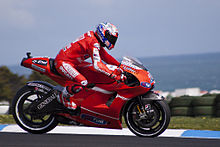
Casey Stoner in action at the 2010 Australian motorcycle Grand Prix at the Phillip Island Grand Prix Circuit.
1990: Phillip Island hosts its first round of the Superbike World Championship. The circuit also hosts its first sprint round of the Australian Touring Car Championship.
1996: Australian superbike rider, Troy Corser, wins the Superbike World Championship on board a Ducati at the October race at Phillip Island.
1997: The Australian motorcycle Grand Prix returns to Phillip Island, where it becomes a permanent fixture.
1998: Australian Michael Doohan wins the motorcycle Grand Prix. The first corner is named after him.
2000: Simon Wills sets the current outright lap record of the circuit in the Formula Holden category.
2004: The circuit and surrounding land is purchased by the Linfox corporation with a view to complement the world-famous circuit with world class facilities such as an 18-hole Greg Norman-designed championship golf course and a luxurious 5-star hotel.
2006: A multimillion-dollar re-development was undertaken in late 2006 by the Linfox Group, including the construction of a new karting circuit.
2008: The Phillip Island 500 is run for the first time since 1977, this time for V8 Supercars. The race is held four times before once again becoming defunct.
2012: Australian Casey Stoner wins his sixth consecutive Australian Motorcycle Grand Prix, as well as his last career Grand Prix victory. Before the race, the third corner of the circuit is named after Stoner.[14]
2014: Jamie Whincup becomes the first ever driver to win a sixth ATCC/V8 Supercars title by winning the second Saturday race at the Plus Fitness Phillip Island 400.
Lap records

Phillip Island Grand Prix Circuit Panorama showing turn 12 heading on to the 900m Gardner Straight
In the early 1990s, Phillip Island was used during the Australian summer for pre-season testing by various World Sportscar Championship teams and some Japanese Formula 3000 teams (who generally found travelling to Australia was actually cheaper than paying some $5,000 per hour to hire the Honda owned Suzuka Circuit in Japan). While no official lap times were published, television commentator and race driver Neil Crompton reported in 1990 that the Nissan Motorsports International team with drivers Julian Bailey and Mark Blundell driving the Nissan R90C were able to lap the circuit in around 1:18 while a 3.0 Litre Mugen V8 powered Dome F3000 (which Crompton drove) was able record similar lap times. At the time the fastest Australian cars that raced at Phillip Island were the 3.8 Litre V6 powered Formula Holdens which were approximately 10 seconds per lap slower.[15]
As of September 2018[16]
| Class | Driver | Vehicle | Time | Date |
|---|---|---|---|---|
| Outright |  Simon Wills Simon Wills | Reynard 94D Holden | 1:24.2215 | 13 February 2000 |
| Racing Cars | ||||
Formula Holden | Simon Wills | Reynard 94D Holden | 1:24.2215 | 13 February 2000 |
Formula 3 |  Tim Macrow Tim Macrow | Dallara F307 Mercedes-Benz | 1:24.5146 | 21 September 2013 |
Superkart | Russell Jamieson | Anderson Maverick-DEA | 1:28.1232 | 21 September 2013 |
Formula 5000 | Chris Hyde | McRae GM1 Chevrolet | 1:30.1205 | 9 March 2008 |
Formula 4 | Jayden Ojeda | Mygale F4-Ford | 1:34.0900 | 2 June 2018 |
Formula Ford | Anton de Pasquale | Mygale SJ13a-Ford | 1:35.8901 | 24 November 2013 |
| Touring Cars | ||||
Supercars Championship | Scott McLaughlin | Ford FG X Falcon | 1:31.2142 | 23 April 2017 |
Super2 Series | Garry Jacobson | Ford FG X Falcon | 1:32.3013 | 16 April 2016 |
V8 Touring Car National Series | Garry Jacobson | Ford FG Falcon | 1:33.2611 | 10 September 2016 |
Super Touring | Geoff Brabham | BMW 320i | 1:37.1706 | 1 June 1997 |
Group A | Mark Skaife | Nissan Skyline HR31 GTS-R | 1:40.2312 | 10 March 2013 |
Australian Mini Challenge | Paul Stokell | Mini JCW R56 | 1:44.1491 | 12 September 2008 |
V8 Ute Racing Series | Kim Jane | Holden VE SS Ute | 1:48.6431 | 16 April 2016 |
| Toyota 86 Racing Series | Tim Brook | Toyota 86 | 1:51.9170 | 22 April 2018 |
| Sports Cars | ||||
Group 2A Sports Cars |  James Winslow James Winslow | Radical SR8 Suzuki | 1:25.9294 | 25 May 2013 |
GT Sports Cars | Jack Le Brocq | Mercedes-Benz SLS AMG GT3 | 1:27.1505 | 26 May 2013 |
Carrera Cup | Scott McLaughlin | Porsche 991 GT3 Cup | 1:31.1343 | 24 May 2015 |
Nations Cup | Paul Stokell | Lamborghini Diablo GTR | 1:34.1058 | 10 August 2003 |
| Marque Sports | Steve Owen | Lamborghini Gallardo | 1:34.4309 | 21 November 2009 |
Aussie Racing Cars | Kyle Ensbey | Mustang-Yamaha | 1:45.7423 | 22 April 2018 |
| Motorcycles | ||||
MotoGP |  Jorge Lorenzo Jorge Lorenzo | Yamaha YZR-M1 | 1:27.833 | 29 October 2013 [17][18] |
500cc Grand Prix |  Kenny Roberts, Jr. Kenny Roberts, Jr. | Suzuki RGV500 | 1:32.743 | 1 October 1999 |
250cc Grand Prix | Álvaro Bautista | Aprilia RSV 250 | 1:32.710 | 5 October 2008 |
125cc Grand Prix | Álvaro Bautista | Honda RS125R | 1:36.927 | 17 September 2006 |
Moto2 |  Alex de Angelis Alex de Angelis | Speed Up SF13 | 1:32.814 | 20 October 2013 |
Moto3 | Jack Miller | KTM RC250GP | 1:36.302 | 19 October 2014 |
World Superbikes |  Eugene Laverty Eugene Laverty | Aprilia RSV4 Factory | 1:31.168 | 24 February 2013 |
World Supersports |  Kenan Sofuoğlu Kenan Sofuoğlu | Kawasaki Ninja ZX-6R | 1:33.238 | 24 February 2013 |
Australian Superbikes | Wayne Maxwell | Yamaha YZF-R1 | 1:32.224 | 14 October 2018 |
| 600cc Supersport | Bryan Staring | Yamaha YZF-R6 | 1:35.200 | 17 October 2009 |
Sidecar F1 | Steve Webster/ David James | LCR-Suzuki GSX-R1000 | 1:38.726 | 18 April 1999 |
Sidecar F2 | Terry Goldie/Jamie Crass | LCR-Honda CBR 600 | 1:45.986 | 27 May 2018 |
References
^ ab Walker, Terry (1995). "Phillip Island (pre-war), Vic.". Fast Tracks. Sydney: Turton & Armstrong Pty. Ltd. p. 128. ISBN 0 908031 55 6..mw-parser-output cite.citation{font-style:inherit}.mw-parser-output q{quotes:"""""""'""'"}.mw-parser-output code.cs1-code{color:inherit;background:inherit;border:inherit;padding:inherit}.mw-parser-output .cs1-lock-free a{background:url("//upload.wikimedia.org/wikipedia/commons/thumb/6/65/Lock-green.svg/9px-Lock-green.svg.png")no-repeat;background-position:right .1em center}.mw-parser-output .cs1-lock-limited a,.mw-parser-output .cs1-lock-registration a{background:url("//upload.wikimedia.org/wikipedia/commons/thumb/d/d6/Lock-gray-alt-2.svg/9px-Lock-gray-alt-2.svg.png")no-repeat;background-position:right .1em center}.mw-parser-output .cs1-lock-subscription a{background:url("//upload.wikimedia.org/wikipedia/commons/thumb/a/aa/Lock-red-alt-2.svg/9px-Lock-red-alt-2.svg.png")no-repeat;background-position:right .1em center}.mw-parser-output .cs1-subscription,.mw-parser-output .cs1-registration{color:#555}.mw-parser-output .cs1-subscription span,.mw-parser-output .cs1-registration span{border-bottom:1px dotted;cursor:help}.mw-parser-output .cs1-hidden-error{display:none;font-size:100%}.mw-parser-output .cs1-visible-error{font-size:100%}.mw-parser-output .cs1-subscription,.mw-parser-output .cs1-registration,.mw-parser-output .cs1-format{font-size:95%}.mw-parser-output .cs1-kern-left,.mw-parser-output .cs1-kern-wl-left{padding-left:0.2em}.mw-parser-output .cs1-kern-right,.mw-parser-output .cs1-kern-wl-right{padding-right:0.2em}
^ Walker, Terry (1995). "Phillip Island (pre-war), Vic.". Fast Tracks. Sydney: Turton & Armstrong Pty. Ltd. p. 130. ISBN 0 908031 55 6.
^ John B Blanden, A History of Australian Grand Prix 1928–1939, Volume 1, 1981, page 123
^ Racing in Australia, Motor Sport (magazine), January 1936, page 113
^ Jim Scaysbrook, Phillip Island, A History of Motor Sport Since 1928, Bookworks Pty Ltd, 2005, page 26
^ Jim Scaysbrook, Phillip Island, A History of Motor Sport Since 1928, Bookworks Pty Ltd, 2005, page 38
^ ab Pedr Davis, The Macquarie Dictionary of Motoring, 1986, page 363
^ ab Jim Scaysbrook, Phillip Island, A History of Motor Sport Since 1928, Bookworks Pty Ltd, 2005, page 161-163
^ Jim Scaysbrook, Phillip Island, A History of Motor Sport Since 1928, Bookworks Pty Ltd, 2005, page 107-108
^ Jim Scaysbrook, Phillip Island, A History of Motor Sport Since 1928, Bookworks Pty Ltd, 2005, page 113
^ Terry Walker, Fast Tracks, 1995, page 130
^ Jim Scaysbrook, Phillip Island, A History of Motor Sport Since 1928, Bookworks Pty Ltd, 2005, page 134-135
^ Jim Scaysbrook, Phillip Island, A History of Motor Sport Since 1928, Bookworks Pty Ltd, 2005, page 163-165
^ Turn three presented to Casey Stoner, www.crash.net
^ 1990 Phillip Island Raceway Dunlop Tyre Testing
^ Natsoft Race Results
^ http://resources.motogp.com/files/results/2013/AUS/MotoGP/Q2/Classification.pdf?v1_489add59
^ http://www.motogp.com/en/event/Australia
Further reading
"The Official 50 Race History of the Australian Grand Prix"
External links
 | Wikimedia Commons has media related to Phillip Island Grand Prix Circuit. |
Phillip Island Grand Prix Circuit official website

