Honda Pilot
| Honda Pilot | |
|---|---|
 Pre-facelift 3rd Generation Pilot | |
| Overview | |
| Manufacturer | Honda |
| Production | 2002–present |
| Model years | 2003–present |
| Body and chassis | |
| Class | Mid-size crossover SUV |
| Body style | 5-door SUV |
| Layout | FF (since 2006) / 4WD |
| Related |
|
| Powertrain | |
| Engine | 3.5-liter V6 |
| Chronology | |
| Predecessor | Honda Passport |
The Honda Pilot is a mid-size crossover SUV manufactured by Honda and introduced in 2002.[1]
Primarily aimed at the North American market, the Pilot is the largest SUV from Honda and features three-row seating. Pilots are currently manufactured in Lincoln, Alabama, and the Pilot was produced in Alliston, Ontario until April 2007. The first generation Pilot was released in April 2002 as a 2003 model.[2]
The Pilot shares its platform with the Acura MDX, as well as the Odyssey minivan and the Accord sedan. The Pilot's unibody construction and independent suspension are designed to provide handling similar to that of a car, and it has integrated perimeter frame rails to allow towing and light off-road use.
Prior to the introduction of the Pilot, Honda marketed the compact crossover CR-V, and the Honda Passport, (a rebadged Isuzu Rodeo) that was a pickup truck-based design. The Pilot is Honda's largest SUV, although the 2010 Crosstour surpassed the Pilot in length.[3]
The Pilot is sold in North America and the Middle East, while the Honda MDX (first generation Acura MDX) was marketed in Japan and Australia for several years. The second generation Pilot is also marketed in Russia, Ukraine, and in the Dominican Republic. The Pilot is also sold in the Philippines.[4]
.mw-parser-output .tocleft{float:left;clear:left;width:auto;background:none;padding:.5em .8em 1.4em 0;margin-bottom:.5em}.mw-parser-output .tocleft-clear-left{clear:left}.mw-parser-output .tocleft-clear-both{clear:both}.mw-parser-output .tocleft-clear-none{clear:none}
Contents
1 First generation (2003–2008)
1.1 Specifications
1.2 Design
1.2.1 2006 Facelift
2 Second generation (2009–2015)
2.1 2012 facelift
2.1.1 2013 changes
2.2 Safety
3 Third generation (2016–present)
3.1 2019 facelift
3.2 Safety
4 Sales
5 References
6 External links
First generation (2003–2008)
| First generation | |
|---|---|
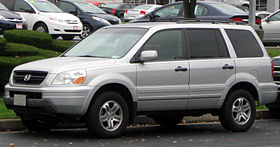 2003-2005 Honda Pilot | |
| Overview | |
| Production | April 2002—2008 |
| Model years | 2003–2008 |
| Assembly |
|
| Designer | Ricky Hsu (1999) |
| Body and chassis | |
| Related |
|
| Powertrain | |
| Transmission | 5-speed automatic |
| Dimensions | |
| Wheelbase | 106.3 in (2,700 mm) |
| Length | 188.0 in (4,775 mm) |
| Width |
|
| Height |
|
Specifications
The 2003-2004 Pilots featured the J35A4 engine, an all-aluminum 3.5L V6 SOHC with VTEC, producing 240 hp (179 kW) and 242 lb⋅ft (328 N⋅m) of torque.
The 2005 Pilot received a new engine, the J35A6, which added drive-by-wire throttle and produced 255 hp (190 kW) and 250 lb⋅ft (339 N⋅m) of torque. Other changes included the transmission with revised 4th and 5th gear ratios providing a smoother transition between gears, along with a new fuel tank design, increasing the Pilot's driving range by over 40 mi (64 km)[5]. All Pilots from 2003-2005 feature VTM-4, Honda’s four-wheel drive system.
The Pilot received more updates starting with the 2006 model year, engines were either the J35Z1 (FWD) or the J35A9 (4WD). Both engines were rated at 244 hp (182 kW) and 240 lb⋅ft (325 N⋅m) of torque; the power reduction is because Honda used the updated SAE net power standard. This was the first time 4WD was not standard on the Pilot.
The new FWD models featured Honda's Variable Cylinder Management (VCM) system, which can deactivate up to three cylinders under light load to increase fuel economy, to help control noise from the system Honda added Active Control Engine Mount System (ACM) and Active Noise Cancellation (ANC). Further this version of the J35 featured updated iVTEC and the automatic transmission a shorter 1st gear ratio. With powertrain updates and the lack of VTM-4 the FWD version had improved fuel economy of 18-city/24-highway, an increase of +1/+2 mpg versus the 4WD.
All Pilots from this generation feature a 5-speed automatic transmission. The Pilot has front struts with a coil-spring, multilink rear suspension for a flat rear load floor. Front track is 66.3 in (1,684 mm) and 66.5 in (1,689 mm) at the rear. The Pilot has a 4,500 lb (2,041 kg) boat/3,500 lb (1,588 kg) trailer towing capability with the optional dealer installed towing package.
Pilots with Honda's Variable Torque Management 4WD system (VTM-4) sent most power to the front wheels under normal driving conditions. Under acceleration or if wheel slippage is detected at the front wheels, up to 50% of power can be sent to the rear wheels. The system also features a VTM-4 lock button on the dashboard which locks the rear differential and sends 25% of the power to each rear wheel. However, the VTM-4 lock function only operates in first gear, second gear and reverse, and automatically disengages above 18 mph (29 km/h), then re-engages when the speed drops below 18 mph (29 km/h).
Design
Design of the Pilot was by Honda's Ricky Hsu through 1999, when styling was approved. The Pilot can accommodate up to eight passengers in three rows configured as stadium seating. The third row can seat three, but the limited legroom makes it suitable only for small children or adults on short trips. Similar to the Honda Odyssey, the rear seats can be folded into flat surfaces for larger cargo. Options include powered moonroof, DVD entertainment system, and a navigation system.[6][7]
Other features include ABS-equipped four-wheel disc brakes, rack-and-pinion steering, four-wheel independent suspension, and 282° of outward visibility.

2006-2008 Honda Pilot
2006 Facelift
Honda revised the Pilot for the 2006 model year in October 2005. Changes to the exterior included a new fascia with a different grille insert and halogen projector headlights, and taillights with clear lenses. The EX trim level received redesigned wheels, and the original EX wheels were now found on the LX trim. On the inside, side airbags were provided in the C pillar, the gauge cluster was updated and the center console featured chrome trim and redesigned storage compartments and cup holders.
Second generation (2009–2015)
| Second generation | |
|---|---|
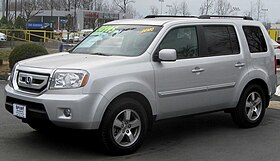 Pre-facelift 2nd Generation Honda Pilot | |
| Overview | |
| Production | April 2008 – 2015 |
| Model years | 2009 – 2015 |
| Assembly | Lincoln, Alabama, United States (HMA) |
| Designer | Dave Marek (2006) |
| Body and chassis | |
| Related |
|
| Powertrain | |
| Engine | Honda J35Z4 V6 |
| Transmission | 5-speed automatic |
| Dimensions | |
| Wheelbase | 109.2 in (2,774 mm) |
| Length |
|
| Width | 78.5 in (1,994 mm) |
| Height |
|

Rear view
The larger second generation Pilot was unveiled as a prototype in January 2008 at the North American International Auto Show. Assembled at Honda Manufacturing of Alabama in Lincoln, Alabama, it was offered in five trims; LX, EX, EX-L, Touring, and SE (2015 only). All second generation Pilots used a new J35Z4 3.5-liter V6 iVTEC engine producing 250 hp (186 kW; 253 PS) SAE net at 5700 rpm and 253 lb⋅ft (343 N⋅m) of torque at 4800 rpm.[8] EPA fuel economy is rated at 17 mpg city /23 mpg highway with front-wheel-drive and 16 mpg city / 22 mpg highway for all-wheel-drive.
Both drivetrains were equipped with five-speed automatics. The second generation's wheelbase is 109.2 in, with a length of 190.9 in, a width of 78.5 in, a height of 71.0 in and interior space of 153.7 cu-ft. The redesigned headlights lost the previous generation's halogen projectors and return to standard halogen reflectors. Features included new two-position memory settings for the driver's seat, a new power tailgate, and the gear shift was relocated from the steering column to the center console between the front seats. The Touring trim included a 120-volt power outlet and a satellite-linked Honda navigation system.
2012 facelift

2012 Honda Pilot EX
The 2012 model year introduced a redesigned front fascia, new alloy wheels, and updates to the interior along with changes to the bumper.
2013 changes
The 2013 model year included a standard rearview backup camera, i-MID central dashboard 8-inch LCD screen, USB connector, Bluetooth hands-free calling and wireless audio streaming, and tri-zone climate control.
Safety
The Pilot uses Honda's Advanced Compatibility Engineering front bracket. For the 2013 model year a rear-view backup camera was made standard. The Insurance Institute for Highway Safety (IIHS) found the Honda Pilot's driver death rate of 2 deaths per million registered among the ten lowest released in their report[9][10]
| Moderate overlap frontal offset | Good |
| Small overlap frontal offset | Poor* |
| Side impact | Good |
| Roof strength | Marginal (2009-11 models) |
| Roof strength | Good (2012 models) |
*vehicle structure also rated "Poor"
| Overall: |   |
| Frontal Driver: | |
| Frontal Passenger: | |
| Side Driver: | |
| Side Passenger: | |
| Side Pole Driver: | |
| Rollover FWD: | / 17.4% |
| Rollover AWD: | / 16.4% |
†Because of more stringent tests, 2011 and newer model ratings are not comparable to pre–2011 ratings.
Third generation (2016–present)
| Third generation | |
|---|---|
 | |
| Overview | |
| Production | May 2015–present |
| Model years | 2016–present |
| Assembly | Lincoln, Alabama, United States (HMA) |
| Designer | Ben Davidson (2012) |
| Body and chassis | |
| Related |
|
| Powertrain | |
| Transmission |
|
| Dimensions | |
| Wheelbase | 111.0 in (2,819 mm) |
| Length | 194.5 in (4,940 mm) |
| Width | 78.6 in (1,996 mm) |
| Height | 69.8 in (1,773 mm) |
| Curb weight |
|

Rear view
The third-generation 2016 Pilot debuted at the Chicago Auto Show in February 2015, production began during May, and was made available for sale in June.
The exterior is sleeker in appearance compared to its boxier predecessor. Added to the exterior are optional LED headlamps with automatic high-low beam switching, LED daytime running lights (DRLs), and LED brake tail lights and the new Elite model. New features also include heated rear seats, ventilated front seats, and a panoramic roof to Elite models only. Alloy wheels became standard.

LaneWatch provides an 80° field of view along the passenger-side of the vehicle giving four-times more visibility than traditional side-view mirrors.
Newly available safety features include Honda's LaneWatch passenger side mirror camera or Blind Spot Information (BSI) and rear Cross Traffic Monitor.[16] Additional options include Lane Departure Warning (LDW) with Lane Keeping Assist System (LKAS) and Road Departure Mitigation (RDM), Forward Collision Warning (FCW) with Collision Mitigation Braking System (CMBS), Adaptive Cruise Control (ACC). A tri-angle backup camera is standard with dynamic guidelines optional.
The revised 3.5-liter V6 engine has direct-injection and start-stop system with improved power at 280 hp (209 kW; 284 PS), a 6-speed automatic is standard while a ZF 9-speed automatic is optional. With all-wheel drive models the amount of engine torque sent to each rear wheel is variable. EPA-estimated fuel economy is improved with front-wheel drive (FWD) 6-speed models registering 19/27/22 mpg, and all-wheel drive (AWD) models registering 18/26/21 mpg (city/highway/combined). 9-speed models see fuel economy of 20/27/23 mpg in FWD configuration and 19/26/22 mpg in AWD.[17]
Overall dimensions are larger, while weight is down approximately 300 pounds with noise, vibration, and harshness (NVH) reduced. Both 2 WD and AWD share the same platform. Structurally 21.3% of the Pilot's body is composed of 980, 1300 and 1,500 MPa ultra-high-strength steels, 5% is from aluminum or magnesium, an additional 34.5% is 270 MPa mild strength steel used in areas to minimize repair costs.[18]
2019 facelift
@media all and (max-width:720px){.mw-parser-output .tmulti>.thumbinner{width:100%!important;max-width:none!important}.mw-parser-output .tmulti .tsingle{float:none!important;max-width:none!important;width:100%!important;text-align:center}}


For the 2019 model year, Honda has refreshed the Pilot inside and out. The powertrain for the Pilot has remained unchanged, but Honda did revise the nine speed transmission only found in the Touring and Elite trims. The exterior now has new bumpers, grille, wheels, LED headlights, and revised taillights. A hands free tailgate is now available. In the interior the gauge cluster is replaced with a new one, similar to the one found on the Odyssey. The infotainment system is updated with Honda's latest software and it also features CabinControl app, from the Odyssey. 4G LTE hotspot, CabinTalk, and a new rear entertainment system are now available. The volume slider is now replaced with a volume knob. Honda has replaced the steering wheel with a new design, also from the Odyssey. Lastly, Honda Sensing is now standard on all trim levels for the Pilot.[19]
Safety
| Moderate overlap frontal offset | Good |
| Small overlap frontal offset | Good1 |
| Side impact | Good |
| Roof strength | Good2 |
| Headlights | Acceptable3 |
1vehicle structure also rated "Good".[21]
2strength-to-weight ratio: 5.22
3only with the elite or touring, poor for other models
| Overall: | |
| Frontal Driver: | |
| Frontal Passenger: | |
| Side Driver: | |
| Side Passenger: | |
| Side Pole Driver: | |
Rollover FWD: | / 17.5% |
| Rollover AWD: | / 16.4% |
Sales
| Calendar year | US sales |
|---|---|
| 2002 | 52,062 |
| 2003 | 106,917 |
| 2004 | 128,158 |
| 2005 | 143,353 |
| 2006 | 152,154 |
| 2007 | 117,146 |
| 2008 | 96,746 |
| 2009 | 83,901 |
| 2010 | 102,323 |
| 2011 | 116,297 |
| 2012 | 114,848 |
| 2013 | 126,678 |
| 2014 | 108,857 |
| 2015 | 136,212[24] |
| 2016 | 120,772[25] |
| 2017 | 127,279 |
References
^ "2009 Honda Pilot vs. Ford Flex and Four Other Crossovers - Comparison Tests". Caranddriver.com. Retrieved 2015-11-08..mw-parser-output cite.citation{font-style:inherit}.mw-parser-output .citation q{quotes:"""""""'""'"}.mw-parser-output .citation .cs1-lock-free a{background:url("//upload.wikimedia.org/wikipedia/commons/thumb/6/65/Lock-green.svg/9px-Lock-green.svg.png")no-repeat;background-position:right .1em center}.mw-parser-output .citation .cs1-lock-limited a,.mw-parser-output .citation .cs1-lock-registration a{background:url("//upload.wikimedia.org/wikipedia/commons/thumb/d/d6/Lock-gray-alt-2.svg/9px-Lock-gray-alt-2.svg.png")no-repeat;background-position:right .1em center}.mw-parser-output .citation .cs1-lock-subscription a{background:url("//upload.wikimedia.org/wikipedia/commons/thumb/a/aa/Lock-red-alt-2.svg/9px-Lock-red-alt-2.svg.png")no-repeat;background-position:right .1em center}.mw-parser-output .cs1-subscription,.mw-parser-output .cs1-registration{color:#555}.mw-parser-output .cs1-subscription span,.mw-parser-output .cs1-registration span{border-bottom:1px dotted;cursor:help}.mw-parser-output .cs1-ws-icon a{background:url("//upload.wikimedia.org/wikipedia/commons/thumb/4/4c/Wikisource-logo.svg/12px-Wikisource-logo.svg.png")no-repeat;background-position:right .1em center}.mw-parser-output code.cs1-code{color:inherit;background:inherit;border:inherit;padding:inherit}.mw-parser-output .cs1-hidden-error{display:none;font-size:100%}.mw-parser-output .cs1-visible-error{font-size:100%}.mw-parser-output .cs1-maint{display:none;color:#33aa33;margin-left:0.3em}.mw-parser-output .cs1-subscription,.mw-parser-output .cs1-registration,.mw-parser-output .cs1-format{font-size:95%}.mw-parser-output .cs1-kern-left,.mw-parser-output .cs1-kern-wl-left{padding-left:0.2em}.mw-parser-output .cs1-kern-right,.mw-parser-output .cs1-kern-wl-right{padding-right:0.2em}
^ "2004 Car Cutaways" (PDF). Automotive News. Retrieved 2015-11-08.
^ Giametta, Chuck (2010-03-21). "2010 Car Comparison: Chevrolet Traverse v Honda Pilot v Toyota Highlander". iGuida. Archived from the original on 2013-05-07. Retrieved 2015-01-07.
^ "2009 Honda Pilot EX-L 4WD Comparison Tests". Car and Driver. Archived from the original on 2011-10-12. Retrieved 2015-11-08.
^ "2005 Pilot Updates".
^ "Patent USD460022 - Vehicle body". google.com. Retrieved 2015-11-08.
^ "All-New Honda Pilot Sport-Utility Vehicle Set to Debut Next Year Pre-Production Model to be Shown at NAIAS". honda.com (Press release). 2001-12-13. Archived from the original on 2016-03-04. Retrieved 2015-11-08.
^ "2009 Honda Pilot - Specifications - Official Honda Site". Automobiles.honda.com. Retrieved 2010-10-03.
^ "Death rates fall as vehicles improve". iihs.org. Retrieved 2015-11-08.
^ "Driver death rates". iihs.org. Retrieved 2015-11-08.
^ "Honda Pilot Crash Test Ratings". IIHS. Archived from the original on 2013-01-15. Retrieved 2016-01-07.
^ "Honda Pilot 2003 - 2016". Honda Merchandise. Retrieved 2016-01-07.
[permanent dead link]
^ "2011 Honda Pilot SUV FWD". NHTSA. Retrieved 2015-11-08.
^ "2011 Honda Pilot SUV AWD". NHTSA. Retrieved 2015-11-08.
^ Gorzelany, Jim. "Will Honda's Ridgeline Spur More 'Crossover' Pickups, Or Become Another Asterisk In Auto History?". Retrieved 11 January 2018.
^ "2016 Honda Pilot - Safety and Driver Assistance - Honda.com". news.honda.com. Retrieved 2018-01-11.
^ "Honda Pilot Fuel Economy". FuelEconomy.gov. Archived from the original on July 8, 2015.
^ "2016 Honda Pilot only 34.5% mild steel, has very specific repair dos and don'ts". Repairer Driven News. Retrieved 2015-11-08.
^ https://www.cnet.com/roadshow/news/2019-honda-pilot-suv-preview
^ "Honda Pilot Crash Test ratings". IIHS. Retrieved 2015-11-08.
^ "2018 Honda Pilot". Retrieved 11 January 2018.
^ "2016 Honda Pilot SUV FWD". NHTSA. Retrieved 2015-11-08.
^ "2016 Honda Pilot SUV AWD". NHTSA. Retrieved 2015-11-08.
^ "American Honda Sets New All-Time Annual Sales Record". Honda Newsroom. Retrieved 2018-01-11.
^ "American Honda Sets All-Time Sales Records Powered by Demand for Cars and Trucks". Honda Newsroom. Retrieved 2018-01-11.
External links
 | Wikimedia Commons has media related to Honda Pilot. |
- Pilot Official US site
Honda Motor Company | |||||||||||||
|---|---|---|---|---|---|---|---|---|---|---|---|---|---|
| Divisions and subsidiaries |
| ||||||||||||
| Joint ventures and shareholdings |
| ||||||||||||
| Aircraft |
| ||||||||||||
| Honda |
| ||||||||||||
| Concept |
| ||||||||||||
| Bikes |
| ||||||||||||
| Engines |
| ||||||||||||
| Aero-Engines |
| ||||||||||||
| Robots |
| ||||||||||||
| People |
| ||||||||||||
| Other |
| ||||||||||||
| |||||||||||||
 Category
 Commons
Honda road car timeline, North American market, 1980s–present | |||||||||||||||||||||||||||||||||||||||||
|---|---|---|---|---|---|---|---|---|---|---|---|---|---|---|---|---|---|---|---|---|---|---|---|---|---|---|---|---|---|---|---|---|---|---|---|---|---|---|---|---|---|
Type | 1980s | 1990s | 2000s | 2010s | |||||||||||||||||||||||||||||||||||||
| 0 | 1 | 2 | 3 | 4 | 5 | 6 | 7 | 8 | 9 | 0 | 1 | 2 | 3 | 4 | 5 | 6 | 7 | 8 | 9 | 0 | 1 | 2 | 3 | 4 | 5 | 6 | 7 | 8 | 9 | 0 | 1 | 2 | 3 | 4 | 5 | 6 | 7 | 8 | 9 | ||
Subcompact | Insight | ||||||||||||||||||||||||||||||||||||||||
Civic | Civic | Civic | Civic | Civic | Fit | Fit | Fit | ||||||||||||||||||||||||||||||||||
Compact | Insight | Insight | |||||||||||||||||||||||||||||||||||||||
Accord | Accord | Accord | Accord | Civic | Civic | Civic | Civic | ||||||||||||||||||||||||||||||||||
Mid-size | Accord | Accord | Accord | Accord Coupe | Accord | Accord | |||||||||||||||||||||||||||||||||||
Clarity | |||||||||||||||||||||||||||||||||||||||||
Full-size | Accord Sedan | ||||||||||||||||||||||||||||||||||||||||
Coupe | Prelude | Prelude | Prelude | Prelude | Prelude | ||||||||||||||||||||||||||||||||||||
Sport compact | CR-X | CR-X | del Sol | CR-Z | Civic Type R | ||||||||||||||||||||||||||||||||||||
Sports car | S2000 | ||||||||||||||||||||||||||||||||||||||||
Crossover | Mini | HR-V | |||||||||||||||||||||||||||||||||||||||
Compact | Element | ||||||||||||||||||||||||||||||||||||||||
CR-V | CR-V | CR-V | CR-V | CR-V | |||||||||||||||||||||||||||||||||||||
| Mid-size | Crosstour | Passport | |||||||||||||||||||||||||||||||||||||||
Pilot | Pilot | Pilot | |||||||||||||||||||||||||||||||||||||||
Sport utility vehicle | Passport | Passport | |||||||||||||||||||||||||||||||||||||||
Minivan | Odyssey | Odyssey | Odyssey | Odyssey | Odyssey | ||||||||||||||||||||||||||||||||||||
Pickup truck | Ridgeline | Ridgeline | |||||||||||||||||||||||||||||||||||||||

