Songpa Sandae Noli
| Songpa Sandae Noli | |
 | |
| Korean name | |
|---|---|
| Hunminjeongeum | 송파산대놀이 |
| Hanja | 松坡山臺놀이 |
| Revised Romanization | Songpa Sandae Noli |
| McCune–Reischauer | Songp'a santae nori |
Songpa Sandae Noli is a type of sandae noli, Korean traditional mask play which has been handed down in the neighborhoods of Songpa-dong[1] and Garak-dong in modern-day Seoul, South Korea. Sandae Noli is a mask dance that developed in Seoul and the mid of metropolitan region.[2][3]
Contents
1 History
2 Preparation
3 Story
4 Cultural significance
5 Gallery
6 See also
7 References
8 Further reading
9 External links
History
Songpa Sandae Noli began with a cheerful parade called georigut (거리굿) or gilnori (길놀이) as circling around the Songpa Market and nearby town in order to attract people to their performance. The two terms literally mean "street shamanistic ritual" and "street performanace" respectively. When parading, they wore masks and costumes, and played a type of marching music, gilgunak (길군악).[4] With a decorative small flag used by farmers or yeonggi (영기, 令旗)[5][6] at the head, the performers followed the musicians in procession. After the parade, they used an amulet to ward off misfortune and to wish everyone in the market to have good health and fortune.[3][7]
Preparation
The performers hold a seomakgosa (서막고사), a kind of jesa, sacrificial rite before the sandaenoli begins. Masks used for the coming performance are placed on a table setting for the jesa along with several varieties of food, and performers pour alcoholic beverages into a bowl and bow toward the table. This rite is to honor the dead and wish them to rest in peace, as well as to expect to have a good performance.[3][7]
Story
It consists of 12 acts called gwajang (과장, 科場) or madang (마당) in Korean. Songpa sandaenoli candidly depicts conflicts between classes and human nature.[7]
Cultural significance
Songpa Sandae Noli was designated as the 49th item on the list of Important Intangible Cultural Properties of Korea by the South Korean Cultural Heritage Administration in 1973.[1][3][6]
Gallery


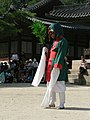
See also
- Talchum
- Namsadang nori
- Important Intangible Cultural Properties of Korea
References
^ ab "Songpasandae maskdance". Andong MaskDance Festival. Archived from the original on 2002-04-26. Retrieved 2010-11-24..mw-parser-output cite.citation{font-style:inherit}.mw-parser-output q{quotes:"""""""'""'"}.mw-parser-output code.cs1-code{color:inherit;background:inherit;border:inherit;padding:inherit}.mw-parser-output .cs1-lock-free a{background:url("//upload.wikimedia.org/wikipedia/commons/thumb/6/65/Lock-green.svg/9px-Lock-green.svg.png")no-repeat;background-position:right .1em center}.mw-parser-output .cs1-lock-limited a,.mw-parser-output .cs1-lock-registration a{background:url("//upload.wikimedia.org/wikipedia/commons/thumb/d/d6/Lock-gray-alt-2.svg/9px-Lock-gray-alt-2.svg.png")no-repeat;background-position:right .1em center}.mw-parser-output .cs1-lock-subscription a{background:url("//upload.wikimedia.org/wikipedia/commons/thumb/a/aa/Lock-red-alt-2.svg/9px-Lock-red-alt-2.svg.png")no-repeat;background-position:right .1em center}.mw-parser-output .cs1-subscription,.mw-parser-output .cs1-registration{color:#555}.mw-parser-output .cs1-subscription span,.mw-parser-output .cs1-registration span{border-bottom:1px dotted;cursor:help}.mw-parser-output .cs1-hidden-error{display:none;font-size:100%}.mw-parser-output .cs1-visible-error{font-size:100%}.mw-parser-output .cs1-subscription,.mw-parser-output .cs1-registration,.mw-parser-output .cs1-format{font-size:95%}.mw-parser-output .cs1-kern-left,.mw-parser-output .cs1-kern-wl-left{padding-left:0.2em}.mw-parser-output .cs1-kern-right,.mw-parser-output .cs1-kern-wl-right{padding-right:0.2em}
^ "Toegyewon Sandaenori". Namyangju City. Archived from the original on 2006-01-18.
^ abcd 송파산대놀이 (松坡山臺──) (in Korean). Empas / EncyKorea.
^ 길군악 (한국 음악) ── 軍樂, 노요곡 (in Korean). Daum / Britannica.
^ 영기 (令旗) (in Korean). Empas / EncyKorea.
^ ab 송파산대놀이 (松坡山臺──) (in Korean). Empas / Britannica.
^ abc "Songpa Sandaenori (Songpa Mask Dance Drama)". Arirang TV. 2007-09-08.
Further reading
.mw-parser-output .refbegin{font-size:90%;margin-bottom:0.5em}.mw-parser-output .refbegin-hanging-indents>ul{list-style-type:none;margin-left:0}.mw-parser-output .refbegin-hanging-indents>ul>li,.mw-parser-output .refbegin-hanging-indents>dl>dd{margin-left:0;padding-left:3.2em;text-indent:-3.2em;list-style:none}.mw-parser-output .refbegin-100{font-size:100%}
"Archived copy" 송파산대놀이 (松坡山臺놀이) (in Korean). Seoul Cultural Affairs Division, Seoul Metropolitan Government. Archived from the original on 2003-07-15. Retrieved 2010-11-24.CS1 maint: Archived copy as title (link)
"Korean masks". Hahoe Mask Museum.
External links
 | Wikimedia Commons has media related to Songpa sandaenori. |
Information and video clip on Songpa Sandae Noli[permanent dead link], Seoul Metropolitan Government
Video with highlights from Songpa Sandae Noli, YouTube
- [http://www.ekoreajournal.net/archive/detail.jsp?BACKFLAG=Y&VOLUMENO=24&BOOKNUM=9&PAPERNUM=5&SEASON=Sep.&YEAR=1984 1984 publication by Cho, Ohkon with the script of Songpa Sandae Noli in English, Korea Journal
- [1]


