FIFA Women's World Rankings
Top 20 rankings as of 29 March 2019[1] | |||
| Rank | Change | Team | Points |
|---|---|---|---|
| 1 |  |  United States United States | 2101 |
| 2 | |  Germany Germany | 2072 |
| 3 |  1 1 |  England England | 2049 |
| 4 |  1 1 |  France France | 2043 |
| 5 | |  Canada Canada | 2006 |
| 6 | |  Australia Australia | 2003 |
| 7 | 1 |  Japan Japan | 1991 |
| 8 | 1 |  Netherlands Netherlands | 1967 |
| 9 | |  Sweden Sweden | 1962 |
| 10 | |  Brazil Brazil | 1944 |
| 11 | |  North Korea North Korea | 1940 |
| 12 | 1 |  Norway Norway | 1915 |
| 13 | 1 |  Spain Spain | 1913 |
| 14 | |  South Korea South Korea | 1883 |
| 15 | 1 |  Italy Italy | 1868 |
| 16 | 1 |  China PR China PR | 1866 |
| 17 | |  Denmark Denmark | 1840 |
| 18 | |  Switzerland Switzerland | 1828 |
| 19 | |  New Zealand New Zealand | 1815 |
| 20 | |  Scotland Scotland | 1812 |
| 20 | 1 |  Belgium Belgium | 1812 |
*Change from 7 December 2018 | |||
Complete rankings at FIFA.com | |||
The FIFA Women's World Rankings for football were introduced in 2003,[2] with the first rankings published in March of that year, as a follow-on to the existing Men's FIFA World Rankings. They attempt to compare the strength of internationally active women's national teams at any given time.
Contents
1 Specifics of the ranking system
2 Leaders
3 Ranking procedure
3.1 Actual result of the match
3.1.1 Actual result table
3.2 Neutral ground or Home vs. Away
3.3 Importance of the match
4 Ranking schedule
5 See also
6 References
7 External links
Specifics of the ranking system
- FIFA Women's World Rankings are based on every international match a team ever played, dating back to 1971, the first FIFA-recognized women's international between France and the Netherlands.
- FIFA Women's World Rankings are implicitly weighted to emphasize recent results.
- FIFA Women's World Rankings are only published four times a year. Normally, rankings are released in March, June, September and December. (In World Cup years, dates may be adjusted to reflect the World Cup results.)
The first two points result from the FIFA Women's World Rankings system being based on the Elo rating system adjusted for football; in 2018, FIFA modified the men's ranking system to similarly be based on Elo systems after continued criticism. FIFA considers the ratings for teams with fewer than 5 matches provisional and at the end of the list. Also any team that plays no matches for 18 months becomes unranked.
Leaders
FIFA Women's
World Ranking leaders

To date Germany and the United States have been the only two teams to have led the rankings. They have also held the top two spots in all but five releases, when Germany was ranked third: Norway was in second position in the first two rankings until Germany overtook them by winning the 2003 FIFA Women's World Cup, Brazil was ranked second in March and June 2009 until Germany won 2009 Euro and rejoined the top two, and England reached the #2 ranking in March 2018.
The United States holds the record for the longest period leading the rankings of nearly 7 years, from March 2008 to December 2014.
Ranking procedure
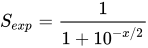
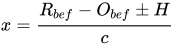
The rankings are based on the following formulae:[2]
- Raft=Rbef+K(Sact−Sexp){displaystyle R_{aft}=R_{bef}+K(S_{act}-S_{exp})}

- Sexp=11+10−x/2{displaystyle S_{exp}={frac {1}{1+10^{-x/2}}}}
- x=Rbef−Obef±Hc{displaystyle x={frac {R_{bef}-O_{bef}pm H}{c}}}
Where
Raft{displaystyle R_{aft}} | = The team rating after the match |
Rbef{displaystyle R_{bef}} | = The team rating before the match |
K{displaystyle K} | = 15M{displaystyle 15M} , the weighted importance of the match , the weighted importance of the match |
Sact{displaystyle S_{act}} | = The actual result of the match, see below |
Sexp{displaystyle S_{exp}} | = The expected result of the match |
x{displaystyle x} | = The scaled difference in rating points between the teams |
Obef{displaystyle O_{bef}} | = The opposing team's rating before the match |
H{displaystyle H} | = The "home advantage" correction, see below |
c{displaystyle c} | = A scaling factor, see below |
M{displaystyle M} | = The "Match Importance Factor", see below |
The average points of all teams are about 1300 points. The top nations usually exceed 2000 points. In order to be ranked, a team must have played at least 5 matches against officially ranked teams, and have not been inactive for more than 18 months. Even if teams are not officially ranked, their points rating is kept constant until they play their next match.
Actual result of the match
The main component of the actual result is whether the team wins, loses, or draws, but goal difference is also taken into account.
If the match results in a winner and loser, the loser is awarded a percentage given by the accompanying table, with the result always less than or equal to 20% (for goal differences greater than zero). The result is based on the goal difference and the number of goals they scored. The remaining percentage points are awarded to the winner. For example, a 2–1 match has the result awarded 84%–16% respectively, a 4–3 match has the result awarded 82%–18%, and an 8–3 match has the result awarded 96.2%–3.8%. As such, it is possible for a team to lose points even if they win a match, assuming they did not "win by enough".
If the match ends in a draw the teams are awarded the same result, but the number depends on the goals scored so the results will not necessarily add up to 100%. For example, a 0–0 draws earns both teams 47% each, a 1–1 draw earns 50% each, and a 4–4 draw earns 52.5% each.[2]
Actual result table
Goal Difference | |||||||
| 0 | 1 | 2 | 3 | 4 | 5 | 6 /+ | |
| Goals scored by non winning team | Actual result (percentage) | ||||||
| 0 | 47.0 / 47.0 | 85.0 / 15.0 | 92.0 / 8.0 | 96.0 / 4.0 | 97.0 / 3.0 | 98.0 / 2.0 | 99.0 / 1.0 |
| 1 | 50.0 / 50.0 | 84.0 / 16.0 | 91.1 / 8.9 | 95.2 / 4.8 | 96.3 / 3.7 | 97.4 / 2.6 | 98.5 / 1.5 |
| 2 | 51.0 / 51.0 | 83.0 / 17.0 | 90.2 / 9.8 | 94.4 / 5.6 | 95.6 / 4.4 | 96.8 / 3.2 | 98.0 / 2.0 |
| 3 | 52.0 / 52.0 | 82.0 / 18.0 | 89.3 / 10.7 | 93.6 / 6.4 | 94.9 / 5.1 | 96.2 / 3.8 | 97.5 / 2.5 |
| 4 | 52.5 / 52.5 | 81.0 / 19.0 | 88.4 / 11.6 | 92.8 / 7.2 | 94.2 / 5.8 | 95.6 / 4.4 | 97.0 / 3.0 |
| 5 | 53.0 / 53.0 | 80.0 / 20.0 | 87.5 / 12.5 | 92.0 / 8.0 | 93.5 / 6.5 | 95.0 / 5.0 | 96.5 / 3.5 |
Source[2]
Neutral ground or Home vs. Away
Historically, home teams earn 66% of the points available to them, with away teams earning the other 34%. To account for this, when two teams are not playing on neutral ground, the home team has its Rbef{displaystyle R_{bef}}
This also helps define the scaling constant c{displaystyle c}
Importance of the match
| Match importance | Match importance factor (M) | K-value |
|---|---|---|
FIFA Women's World Cup match | 4 | 60 |
Women's Olympic football tournament | 4 | 60 |
FIFA Women's World Cup qualifier | 3 | 45 |
| Women's Olympic football qualifier | 3 | 45 |
| Women's Continental finals match | 3 | 45 |
| Women's Continental qualifier | 2 | 30 |
| Women's friendly match between two Top 10 teams | 2 | 30 |
| Women's friendly match | 1 | 15 |
Ranking schedule
Rankings are published four times a year, usually on a Friday.[3]
| 2018 Rankings schedule | |
|---|---|
| Release date | |
| 23 March | |
| 22 June | |
| 28 September | |
| 7 December | |
See also


- Elo football rating
- FIFA Men's World Rankings
- Statistical association football predictions
- Geography of women's association football
References
^ abcd "The FIFA/Coca-Cola Women's World Ranking". FIFA. 29 March 2019. Retrieved 29 March 2019..mw-parser-output cite.citation{font-style:inherit}.mw-parser-output .citation q{quotes:"""""""'""'"}.mw-parser-output .citation .cs1-lock-free a{background:url("//upload.wikimedia.org/wikipedia/commons/thumb/6/65/Lock-green.svg/9px-Lock-green.svg.png")no-repeat;background-position:right .1em center}.mw-parser-output .citation .cs1-lock-limited a,.mw-parser-output .citation .cs1-lock-registration a{background:url("//upload.wikimedia.org/wikipedia/commons/thumb/d/d6/Lock-gray-alt-2.svg/9px-Lock-gray-alt-2.svg.png")no-repeat;background-position:right .1em center}.mw-parser-output .citation .cs1-lock-subscription a{background:url("//upload.wikimedia.org/wikipedia/commons/thumb/a/aa/Lock-red-alt-2.svg/9px-Lock-red-alt-2.svg.png")no-repeat;background-position:right .1em center}.mw-parser-output .cs1-subscription,.mw-parser-output .cs1-registration{color:#555}.mw-parser-output .cs1-subscription span,.mw-parser-output .cs1-registration span{border-bottom:1px dotted;cursor:help}.mw-parser-output .cs1-ws-icon a{background:url("//upload.wikimedia.org/wikipedia/commons/thumb/4/4c/Wikisource-logo.svg/12px-Wikisource-logo.svg.png")no-repeat;background-position:right .1em center}.mw-parser-output code.cs1-code{color:inherit;background:inherit;border:inherit;padding:inherit}.mw-parser-output .cs1-hidden-error{display:none;font-size:100%}.mw-parser-output .cs1-visible-error{font-size:100%}.mw-parser-output .cs1-maint{display:none;color:#33aa33;margin-left:0.3em}.mw-parser-output .cs1-subscription,.mw-parser-output .cs1-registration,.mw-parser-output .cs1-format{font-size:95%}.mw-parser-output .cs1-kern-left,.mw-parser-output .cs1-kern-wl-left{padding-left:0.2em}.mw-parser-output .cs1-kern-right,.mw-parser-output .cs1-kern-wl-right{padding-right:0.2em}
^ abcde "Fact Sheet, FIFA Women's World Ranking" (PDF). Retrieved 2015-06-08.
^ "Women's Ranking Procedure". FIFA/Coca-Cola World Ranking. FIFA. Retrieved 11 January 2018.
External links
- FIFA/Coca-Cola Women's World Ranking at FIFA.com
- Women's World Ranking Procedure at FIFA.com
- Women’s World Ranking Fact Sheet
International women's association football | ||
|---|---|---|
| ||
| Asia |
|  |
| Africa |
| |
| North America, Central America and the Caribbean |
| |
| South America |
| |
| Oceania |
| |
| Europe |
| |
| Non-FIFA |
| |
| Games |
| |
| Worldwide |
| |
| ||

