354th Fighter Group
| 354th Fighter Group | |
|---|---|
 P-51 Mustang of the 356th Fighter Squadron, 354th Fighter Group | |
| Active | 15 November 1942 – 31 March 1946 |
| Country | United States |
| Branch | United States Army Air Forces |
| Type | Fighter group |
| Part of | 100th Fighter Wing Ninth Air Force |
| Nickname(s) | Pioneer Mustang Group |
| Motto(s) | Valor in Combat |
| Engagements | Air Offensive, Europe Normandy Market Garden Battle of the Bulge Invasion of Germany |
| Decorations | Distinguished Unit Citation (2) Croix de Guerre with Palm |
| Website | http://www.354thpmfg.com/ |
| Insignia | |
| 354th Fighter Group Emblem |  |
| 353rd Fighter Squadron | FT |
| 355th Fighter Squadron | GQ |
| 356th Fighter Squadron | AJ |
| Aircraft flown | |
| Fighter | P-47 Thunderbolt 1944–1945 P-51 Mustang 1943–1945 |
The 354th Fighter Group was an element of the United States Army Air Forces (USAAF) Ninth Air Force during World War II.[1][2][3] The unit was known as the Pioneer Mustang Group and was the first to fly the P-51B Mustang in combat. The group served as bomber escort in the European theater of operations until D-Day, then moved to France to support the drive to Germany.
Contents
1 Training in the United States
2 Deployment to Europe
3 Return to the United States
4 Notable pilots
5 References
6 External links
Training in the United States
The 354th Fighter Group was constituted on November 12 and activated on November 15th, 1942 at Hamilton Army Airfield in California.[4] The Group trained with the Bell P-39 Airacobra, one of the principal fighter aircraft in service at the time. The group transferred to Tonopah Army Air Field, Nevada in January 1943, Santa Rosa Army Air Field, California in March 1943, and Portland Army Air Base, Oregon, in June 1943
Deployment to Europe
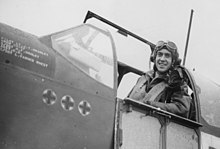
Jack T. Bradley, triple ace and commander of the 353rd Fighter Squadron
The Group moved to RAF Boxted in England between October and November 1943 and was attached to the Ninth Air Force. The group was assigned P-51 Mustang aircraft and was the first to use them in combat. These aircraft were used by the group throughout the war except for the period between November 1944 and February 1945 when they used the P-47 Thunderbolt.
The 354th was used as an escort for long-range heavy bombers of the Eighth Air Force. The Group received a Distinguished Unit Citation for its activities up to May 1944.
The Group moved to RAF Lashenden in April 1944.
Major James H. Howard commander of the 356th Fighter Squadron received the Medal of Honor for single-handedly defending a formation of B-17 bombers of the 401st Bomb Group against 30 German fighters on January 11, 1944. Howard was the only fighter pilot in the European Theater of Operations in World War II to receive the Medal of Honor.
The Group supported the Normandy invasion in Jun 1944 by escorting gliders on D-Day and attacking ground targets such as bridges, railways, and German gun positions in northern France
The Group moved to Cricqueville Airfield in France in June 1944, to Gael Airfield in August 1944, Orconte Airfield, in September 1944, and Rosieres En Haye Airfield, in December 1944.
The 354th received a second Distinguished Unit Citation for destroying a large number of enemy aircraft on the ground an in the air in support of the airborne attack on Holland in September 1944.
The Group participated in the Battle of the Bulge from December 1944 to January 1945 supporting ground forces and supported the
crossing of the Rhine between February and May 1945. The Group moved into Germany in April 1945 to Ober Olm Airfield (Y-64) then to Ansbach Airfield and to AAF Station Herzogenaurach in May 1945.
Return to the United States
The Group returned to Bolling Field, Washington, DC in February 1946 and was inactivated on 31 Mar 1946.
The 354th Fighter Group was redesignated 117th Fighter Group and assigned to the Alabama Air National Guard on 24 May 1946.[4] However, on 26 Sep 1956, the group returned to the Air Force where 354th lineage is now held by the 354th Operations Group. The 117th Fighter Group lineage is held by the 117th Operations Group of the Alabama Air National Guard.
Notable pilots

Wau Kau Kong of the 353rd Fighter Squadron was the first Chinese American fighter pilot
Glenn T. Eagleston was the leading ace of the 354th Fighter Group and a commander of the 353rd Fighter Squadron.[2] Eagleston was credited with 18.5 aerial victories, two probable, seven damaged, and five aircraft destroyed on the ground.[5]
Don M. Beerbower was the second leading ace with 15.5 victories. He was shot down and killed on August 9, 1944. near Reims, France.
Jack T. Bradley was a commanding officer of the 353rd Fighter Squadron and the third leading ace in the 354th Fighter Group.
Kenneth H. Dahlberg of the 353rd Fighter Squadron was credited with 14 aerial victories.[6] Dahlberg was shot down three times and was able to return to the 354th twice. On February 14, 1945, Dahlberg was downed for the third time, near Bitburg, and became a prisoner of war until May 1945.[6]
Wah Kau Kong was born in Honolulu, Hawaii and was America's first Chinese American fighter pilot.[7] He was killed in action over Blomberg, Germany on February 22, 1944.
References
^ Steve Blake (2008). The Pioneer Mustang Group: The 354th Fighter Group in World War II. Schiffer Military History. ISBN 978-0-7643-2925-8..mw-parser-output cite.citation{font-style:inherit}.mw-parser-output .citation q{quotes:"""""""'""'"}.mw-parser-output .citation .cs1-lock-free a{background:url("//upload.wikimedia.org/wikipedia/commons/thumb/6/65/Lock-green.svg/9px-Lock-green.svg.png")no-repeat;background-position:right .1em center}.mw-parser-output .citation .cs1-lock-limited a,.mw-parser-output .citation .cs1-lock-registration a{background:url("//upload.wikimedia.org/wikipedia/commons/thumb/d/d6/Lock-gray-alt-2.svg/9px-Lock-gray-alt-2.svg.png")no-repeat;background-position:right .1em center}.mw-parser-output .citation .cs1-lock-subscription a{background:url("//upload.wikimedia.org/wikipedia/commons/thumb/a/aa/Lock-red-alt-2.svg/9px-Lock-red-alt-2.svg.png")no-repeat;background-position:right .1em center}.mw-parser-output .cs1-subscription,.mw-parser-output .cs1-registration{color:#555}.mw-parser-output .cs1-subscription span,.mw-parser-output .cs1-registration span{border-bottom:1px dotted;cursor:help}.mw-parser-output .cs1-ws-icon a{background:url("//upload.wikimedia.org/wikipedia/commons/thumb/4/4c/Wikisource-logo.svg/12px-Wikisource-logo.svg.png")no-repeat;background-position:right .1em center}.mw-parser-output code.cs1-code{color:inherit;background:inherit;border:inherit;padding:inherit}.mw-parser-output .cs1-hidden-error{display:none;font-size:100%}.mw-parser-output .cs1-visible-error{font-size:100%}.mw-parser-output .cs1-maint{display:none;color:#33aa33;margin-left:0.3em}.mw-parser-output .cs1-subscription,.mw-parser-output .cs1-registration,.mw-parser-output .cs1-format{font-size:95%}.mw-parser-output .cs1-kern-left,.mw-parser-output .cs1-kern-wl-left{padding-left:0.2em}.mw-parser-output .cs1-kern-right,.mw-parser-output .cs1-kern-wl-right{padding-right:0.2em}
^ ab William N Hess (20 December 2012). 354th Fighter Group. Bloomsbury Publishing. ISBN 978-1-78200-858-3.
^ History in the Sky: 354th Pioneer Mustang Fighter Group. Taylor Publishing Company. 1946.
^ ab Maurer, Maurer, ed. (1983) [1961]. Air Force Combat Units of World War II (PDF) (reprint ed.). Washington, DC: Office of Air Force History. ISBN 0-912799-02-1. LCCN 61060979.
^ "Factsheets : Colonel Glenn Todd Eagleston". Hill Air Force Base. October 19, 2010. Archived from the original on 2016-03-28. Retrieved March 26, 2016.
^ ab Robbins, Seth (March 27, 2010). "Plane's remnants unearthed, and a pilot's tale emerges". Stars and Stripes (Online ed.).
^ Dean C. Sensui; Mun Charn Wong (1993). Wah Kau Kong: America's First Chinese-American Fighter Pilot.
External links
 | Wikimedia Commons has media related to 354th Fighter Group (United States Army Air Forces). |
"354th Fighter Group". America Air Museum in Britain. Retrieved 2018-07-07.
 USAAF Ninth Air Force in World War II USAAF Ninth Air Force in World War II | |||||||||||||||||||||||||||
|---|---|---|---|---|---|---|---|---|---|---|---|---|---|---|---|---|---|---|---|---|---|---|---|---|---|---|---|
| Stations |
|  | |||||||||||||||||||||||||
| Units |
| ||||||||||||||||||||||||||
| |||||||||||||||||||||||||||
Authority control  |
|
|---|

