Asian ostrich
| Asian ostrich Temporal range: 3.6–0.008 Ma PreЄ Є O S D C P T J K Pg N ↓ | |
|---|---|
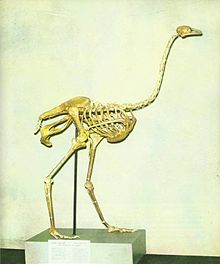 | |
| Asian ostrich skeleton | |
Conservation status | |
Extinct (before 13,000-7,000 BC) | |
Scientific classification  | |
| Kingdom: | Animalia |
| Phylum: | Chordata |
| Class: | Aves |
| Order: | Struthioniformes |
| Family: | Struthionidae |
| Genus: | Struthio |
| Species: | †S. asiaticus |
Binomial name | |
†Struthio asiaticus Milne-Edwards, 1871[1] | |
Synonyms | |
| |
The Asian or Asiatic ostrich (Struthio asiaticus), is an extinct species of ostrich that ranged from Morocco, the Middle East to China and Mongolia. Fossils date from the upper Pliocene to the early Holocene (3.6 MYA - c.6000 BC or BCE).[2] Beads made from shells taken from archaeological sites in India dating to more than 25000 years were found to have traces of DNA and analysis of sequences examined from them show that the species is definitely in the genus Struthio.[3]
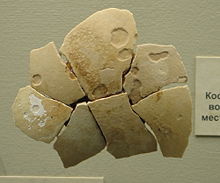
Asian ostrich egg shells
Asian ostriches were widespread around Europe and Asia. They also used to live in northern Indian Subcontinent and southern Siberia. In China, it is known that Asiatic ostriches became extinct at the end or shortly after the end of the last Ice Age.
See also

Late Quaternary prehistoric birds
Footnotes
^ Sharpe, R. Bowdler (1899)
^ Paleobiology Database (2012)
^ Jain, Sonal; Rai, Niraj; Kumar, Giriraj; Pruthi, Parul Aggarwal; Thangaraj, Kumarasamy; Bajpai, Sunil; Pruthi, Vikas (2017). "Ancient DNA Reveals Late Pleistocene Existence of Ostriches in Indian Sub-Continent". PLOS ONE. 12 (3): e0164823. doi:10.1371/journal.pone.0164823. PMC 5342186. PMID 28273082..mw-parser-output cite.citation{font-style:inherit}.mw-parser-output .citation q{quotes:"""""""'""'"}.mw-parser-output .citation .cs1-lock-free a{background:url("//upload.wikimedia.org/wikipedia/commons/thumb/6/65/Lock-green.svg/9px-Lock-green.svg.png")no-repeat;background-position:right .1em center}.mw-parser-output .citation .cs1-lock-limited a,.mw-parser-output .citation .cs1-lock-registration a{background:url("//upload.wikimedia.org/wikipedia/commons/thumb/d/d6/Lock-gray-alt-2.svg/9px-Lock-gray-alt-2.svg.png")no-repeat;background-position:right .1em center}.mw-parser-output .citation .cs1-lock-subscription a{background:url("//upload.wikimedia.org/wikipedia/commons/thumb/a/aa/Lock-red-alt-2.svg/9px-Lock-red-alt-2.svg.png")no-repeat;background-position:right .1em center}.mw-parser-output .cs1-subscription,.mw-parser-output .cs1-registration{color:#555}.mw-parser-output .cs1-subscription span,.mw-parser-output .cs1-registration span{border-bottom:1px dotted;cursor:help}.mw-parser-output .cs1-ws-icon a{background:url("//upload.wikimedia.org/wikipedia/commons/thumb/4/4c/Wikisource-logo.svg/12px-Wikisource-logo.svg.png")no-repeat;background-position:right .1em center}.mw-parser-output code.cs1-code{color:inherit;background:inherit;border:inherit;padding:inherit}.mw-parser-output .cs1-hidden-error{display:none;font-size:100%}.mw-parser-output .cs1-visible-error{font-size:100%}.mw-parser-output .cs1-maint{display:none;color:#33aa33;margin-left:0.3em}.mw-parser-output .cs1-subscription,.mw-parser-output .cs1-registration,.mw-parser-output .cs1-format{font-size:95%}.mw-parser-output .cs1-kern-left,.mw-parser-output .cs1-kern-wl-left{padding-left:0.2em}.mw-parser-output .cs1-kern-right,.mw-parser-output .cs1-kern-wl-right{padding-right:0.2em}
References
Sharpe, R. Bowdler (1899). A Handlist of the Genera and Species of Birds. Vol. I. Red Lion Court Fleet Street, London UK: Taylor and Francis. p. 2. Retrieved 1 February 2010.
Paleobiology Database (2012). "Struthio asiaticus". Paleobiology Database. Paleobiology Database. Retrieved 14 Jun 2012.
Janz, Lisa; Robert G. Elston; George S. Burr (2009). "Dating North Asian Surface Assemblages with Ostrich Eggshell: implications for palaeoecology and extirpation". Journal of Archaeological Science. 36 (9): 1982. doi:10.1016/j.jas.2009.05.012. Retrieved 2014-04-17.
 | This bird-related article is a stub. You can help Wikipedia by expanding it. |

