Huazhong University of Science and Technology
 | |
| Motto | 明德厚学,求是创新[1] (Chinese) |
|---|---|
Motto in English | Virtue, Knowledge, Truth, Originality[2] |
| Type | National / Public |
| Established | 1953 (Engineering School) 1907 (Medical School) |
| President | Li Yuanyuan |
Academic staff | 3,448 |
| Undergraduates | 36,000 |
| Postgraduates | 20,040 |
| Location | Wuhan , Hubei , China |
| Campus | Suburban / Main Campus 1160 acres/ 470 ha Urban / Medical Campus 133 acres/ 54 ha |
| Athletics | National CUBA men's and women's |
| Colors | Blue Red |
| Mascot | Yellow Crane and White Cloud |
| Website | www.hust.edu.cn |
The Huazhong University of Science and Technology (HUST; simplified Chinese: 华中科技大学; traditional Chinese: 華中科技大學; pinyin: Huázhōng Kējì Dàxué) is a public, coeducational research university located in Guanshan Subdistrict, Hongshan District, Wuhan, Hubei province, China. As a national key university directly affiliated to the Ministry of Education of China, HUST is a Project 985 and Class A Double First Class University.[3]
HUST manages Wuhan National Laboratories for Opto-electronics (WNLO), which is one of the five national laboratories in China. HUST is also one of four Chinese universities eligible to run the national laboratory and the national major science and technology infrastructure. Huazhong University of Science and Technology was one of two Chinese universities awarded with the “University Leadership Award” by the Society of Manufacturing Engineers (SME) , and elected as “China's Top Ten Research Institutions”by the world-famous academic journal Nature,[4] called "The epitome of the development of higher education in People's Republic of China."
Contents
1 History
1.1 Founding (1952-1954)
1.2 Early development (1954-1966)
1.3 Cultural Revolution (1966-1976)
1.4 New mission, global view (1976-1988)
1.5 Leading the Reform in Tech-Schools (1988-2000)
1.6 Merger
1.7 Tongji Medical College
1.8 Presidents (1953- )
2 Campus
2.1 Main Campus at Wuchang
2.2 Tongji Medical Campus at Hankou
3 Schools and Departments
3.1 Sciences and Engineering
3.2 Social Sciences
3.3 Medicine (Tongji Medical College)
4 Academic Power
4.1 Faculty and staff
4.2 National scientific platforms
4.2.1 National Laboratory
4.2.2 National major science and technology infrastructure
4.2.3 State Key Laboratory
4.2.4 National Engineering (Technology) Research Center
4.2.5 National Engineering Laboratory
4.2.6 National Professional Laboratory
4.3 Essential Science Indicators(ESI)
4.4 Discipline Category
4.5 Programs[7]
4.6 Subjects[8]
5 World and Domestic Reputation
6 Services
6.1 Libraries
7 Student life
7.1 Student demographics
7.2 Athletics
8 Notable faculty and alumni (incomplete statistics)
8.1 Notable alumni
8.2 Members of National Academies
8.2.1 China Academy of Sciences
8.2.2 China Academy of Engineering
8.2.3 Famous scientists
9 References
10 External links
History

Main Campus

Main Gate

The gate of Huazhong University of Science and Technology in Winterday
Founding (1952-1954)
In 1952, the Central Government of China sought to construct a new higher education system for the rapid development of economy, science and technology after Chinese Civil War. Three technical institutes were planned to be established in Wuhan, including Huazhong Institute of Technology (HIT, 华中工学院), South-Central China Institute of Power Engineering (中南动力学院) and South-Central China Institute of Water Conservancy and Electric Power (中南水利学院) . In March 1953, the institute's charter was signed by the South-Central China Government under the approval of the Central Government of China. In the original planning, the land south of the Yujia Hill was chosen for the three campuses. Physicist Qian Zha was appointed as chair of the three-institute initiative. Economist Peigang Zhang was appointed as chief in planning to lead the HIT initiative. In June 1953, the land south of the East Lake was chosen as the campus of South-Central China Institute of Water Conservancy and Electric Power. The same year, the South-Central China government decided not to establish an independent South-Central China Institute of Power Engineering. All the programs related to power engineering were administered by Huazhong Institute of Technology. The institute formally opened on October 15, 1953.
Early development (1954-1966)
All the programs and departments at HIT were organized and formed from the programs related to electrical engineering, power engineering, electricity and mechanical engineering in Wuhan University, Hunan University, Guangxi University and South China Institute of Technology. HIT's first classes were held in spaces at those institutions. There were eight undergraduate programs, 314 full-time faculty members and 2,639 undergraduate students at that time. The first president is physicist Qian Zha, Dean of School of Engineering of Wuhan University. The first provost is Gancai Liu.
In 1960, HIT was evaluated to be a national key university under the direct administration of the Ministry of Education of China.
Cultural Revolution (1966-1976)
In 1971, most of the Wuhan Mechanical Institute (武汉机械学院) was merged into the institute.
Six departments were established. There were 20 undergraduate programs, 1,097 faculty members. The number of undergraduate students reached to 6,087.
New mission, global view (1976-1988)
Graduate students began to be enrolled in 1978, and in 1984, the institute became one of 22 universities to be approved by the State Council to establish a graduate school. By approval of the State Education Committee, the institute was renamed Huazhong University of Science and Technology (HUST, 华中理工大学) in 1988.
Leading the Reform in Tech-Schools (1988-2000)
With China's global strategy and the reform of the economy, HUST led a series of pivotal reforms among technical institutions in China. HUST is the first technical school to establish the Department of Journalism and Communication, the Department of Economics, and Department of Literature, and to host nationwide lectures in humanities.
Merger
On May 26, 2000, the former Huazhong University of Science and Technology, Tongji Medical University, Wuhan Urban Construction Institute (武汉城市建设学院), and Wuhan Science and Technology Vocational College (科技部干部管理学院) combined to form the new Huazhong University of Science and Technology (华中科技大学); the Chinese name was changed, but the English name remained the same.
Tongji Medical College
The history of Tongji Medical College can be traced back to 1907 when Tongji German Medical School was founded by Erich Paulun in Shanghai. The name Tongji[5] suggests cooperating by riding the same boat. In 1927, with the development of the institution, it expanded to include engineering programs. After the establishment of National Tongji University in 1927, the Tongji Medical College was affiliated to the university as one of the schools. In 1950, the medical school was moved to Wuhan from Shanghai and merged with Wuhan University School of Medicine to become South-Central China Tongji Medical College. The college was later renamed as Wuhan College of Medicine in 1955, as Tongji Medical University in 1985, and as Tongji Medical College of Huazhong University of Science and Technology in 2000.
Presidents (1953- )
- Yuanyuan Li (2018—)Member of China's Academy of Engineering
Ding Lieyun (2014–2018) Member of China's Academy of Engineering- Peigen Li (2005–2014) Member of China's Academy of Engineering
- Mingwu Fan (2001–2005) Member of China's Academy of Engineering, former President of China Institute of Atomic Energy
- Ji Zhou (1997–2001) Member of China's Academy of Engineering, current President of China's Academy of Engineering, former Minister of Education of China
Yang Shuzi (1993–1997) Member of China's Academy of Sciences- Shuhuai Huang (1984–1993)
- Jiusi Zhu: (1979–1984)
- Qian Zha: (1953–1979)
Campus

Road and Youth Lake in main campus HUST.

Overlook of the library in HUST with 72% green rate
Huazhong University of Science and Technology has two campuses: Main Campus at Wuchang and Tongji Medical Campus at Hankou. The area of single campus is more than 7000 mu. The campus reaches 72% green rate and thus is also known as "Forest University".
Main Campus at Wuchang
1037 Luoyu Road, Wuchang, Wuhan
Tongji Medical Campus at Hankou
13 Hangkong Road, Hankou, Wuhan
Schools and Departments

West12 at Night. All buildings at HUST are named in Direction+Number.

A classroom in West12.
Sciences and Engineering
- School of Physics
- School of Automation
- Department of Electronic Sci. & Tech.
- Department of Electronics & Information Engr.
- Department of Mathematics
- School of Architecture & Urban Planning
- School of Chemistry & Chemical Engr.
- School of Computer Sciences & Engr.
- School of Civil Engineering & Mechanics
- School of Electrical & Electronic Engr.
- School of Energy & Power Engineering
- School of Environmental Science & Engr.
- School of Hydropower & Information Engr.
- School of Life Sciences & Technology
- School of Materials Science & Engr.
- School of Mechanical Science & Engr.
- School of Naval Architecture & Ocean Engr.
- School of Aerospace Engineering
- School of Optical & Electronic Information
- School of Software Engineering
- School of Transportation Sci. & Engr.
Social Sciences
- Department of Chinese Literature
- Department of Philosophy
- Department of Political Science
- Department of Sociology
- School of Economics
- School of Education
- School of Foreign Language
- School of Humanities & Social Sciences
- School of International Education
- School of Journalism & Communication
- School of Law
- School of Management
- School of Public Administration
Medicine (Tongji Medical College)
- Department of Forensic Medicine
- Department of Nursing
- Basic Medical School
- School of Clinical Medicine I
- School of Clinical Medicine II
- School of Drug & Health Administration
- School of Pharmacy
- School of Public Health
Academic Power
Faculty and staff
- Faculty: 3,448
- Staff (main campus): 7,659
- Staff (hospitals): 5,259
- Distinguished Youth Scholars awarded by National Science Fund:69
Chang Jiang Scholars (Distinguished Professors): 65- Fellows of Chinese Academy of Sciences: 12
- Fellows of Chinese Academy of Engineering: 17
National scientific platforms

Wuhan National Laboratory for Optoelectronics, HUST
National Laboratory
- Wuhan National Laboratories for Opto-electronics (WNLO), one of the five national laboratories in China
National major science and technology infrastructure
- Wuhan National High Magnetic Field Center, one of Top 4 magnetic field centers in the world, No.1 in Asia.
- Precision gravity measurement research facility, known as "World Gravity Center" by the international physics circle, measuring the most accurate gravitational constant in 2018.
State Key Laboratory
- State Key Laboratory of Digital Manufacturing Equipment and Technology
- State Key Laboratory of Coal Combustion
- State Key Laboratory of Materials Processing and Die & Mould Technology
- State Key Laboratory of Advanced Electromagnetic Engineering and Technology (AEET)
National Engineering (Technology) Research Center
- National Engineering Research Center for Laser Processing
- National Engineering Research Center for Digital Manufacturing Equipment
- National Engineering Technology Research Center for Enterprise Information Technology (CAD) Application Support Software(Wuhan)
- National NC System Engineering Research Center
- National Anti-counterfeiting Engineering Technology Research Center
- National Nanomedical Engineering Technology Research Center
National Engineering Laboratory
- National Engineering Laboratory of Next Generation Internet Access System
National Professional Laboratory
- National Professional Laboratory of New Motor
- National Professional Laboratory of External Storage Systems
Essential Science Indicators(ESI)
In ESI ranking in November 2018, Huazhong University of Science and Technology is ranked in 281th in the world, and 9th among all the Double First Class Universities. The numbers of top 1‰ and 1% disciplines of HUST in the world are 3 and 15 respectively.
Top 1‰ disciplines include Engineering, Computer Science, Materials Science. Top 1% disciplines include Engineering, Computer Science, Materials Science, Clinic Medicine, Chemistry, Pharmacology & Toxicology, Biology & Biochemistry, Physics, Neuroscience & Behavior, Social Sciences, Molecular Biology & Genetics, Mathematics, Environment/Ecology, Agricultural Sciences.
Discipline Category
Undergraduate|Graduate[6]
Engineering: #6 | #3;
Medicine: #2 | #2;
Management: #10 | #15;
Science: #16 | #17;
Economics: #20 |-;
Literature: #36 |-;
Natural Sciences (Engineering, Medicine, Science overall): #7 | #6;
Social Sciences (History, Management, Economics overall): #17 | #18
Programs[7]
Mechanical Engineering: #1;
Electrical Engineering: #2;
Optical Engineering: #1;
Public Health: #1;
Public Administration: #4;
Biomedical Engineering: #5;
Control Engineering: #5 ;
Power Engineering: #6;
Computer Science: #9;
Electronics: #9;
Subjects[8]
Preventive Medicine
Epidemiology: #5;
Environmental Health: #1;
Nutrition: #5;
Gynecology: #2;
Toxicology: #6;
Computer Science
System Structure: #3;
Software: #12 ;
Journalism & Communication
Journalism: #3;
Communication: #7;
Others
Statistics: #6;
Quantitative Economics: #3;
World and Domestic Reputation
- 2019 US News and World Report (U.S. News): 260th in the world, and 9th in China.[9]
- 2018 Academic Ranking of World Universities(ARWU): 151-200th in the world, and the 8th-12th in China.[10]
- 2019 Times Higher Education(THE): 351-400th in the world, and the 10th in China.[11]
- 2018 China University Ranking issued by Wu Shulian: the 8th in China.[12]
- 2018 China Best University Ranking issued by Shanghai Ranking Consultancy(authorized by Eduction Ministry of China): the 8th in China.[13]
Services
Libraries

Russia-style library in the main campus

New Library, main campus
There are four libraries at HUST: the Old Library, the Shaw Library (New Library), the Medical Library and the Architecture Library. The Old Library and the Shaw Library are located in the center of main campus. The Old Library was designed and constructed in Soviet-Union style in the 1950s. It plays a major role in book circulation and conference hosting. It also provides classrooms for audio-video teaching program and some group-study programs. The first floor of the east wing is the Center for Reader's Services, which is a branch of University Bookstore System. The Shaw Library was donated by Sir Run Run Shaw and built in the 1990s. It has more than 30 reading rooms, including Chinese/English social sciences reading rooms, Chinese/English natural sciences reading rooms, Chinese/English archive reading rooms and electronic journal reading rooms. It also houses a multi-media center and a major branch of Center for Computing & Networking. Medical Library is located in Tongji Medical Campus in Hankou. It provides the same services to the medical students as the libraries in main campus. The Architecture Library is on the east side of the main campus. It accommodates books and journals in architecture and urban planning. The University Libraries have a total collection of 3.49 million volumes.
Student life
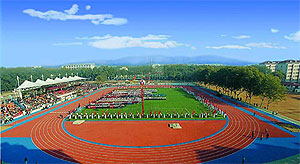
University Stadium, main campus

A path of Yujia Hill (located at the back of the main campus)
Student demographics
Undergraduate students: 36,275
Graduate & professional students: 20,044
International students: 560
Athletics
HUST men's basketball team has won national championship (CUBA) in 2004. HUST men's team also won the fourth place in CUBA 1999. HUST women's basketball team lost the national champion titles and won the second places in WCUBA 2005 and 2006.
Notable faculty and alumni (incomplete statistics)
Notable alumni
Lou Qinjian, HIT Class 1981, CPC Secretary of Jiangsu Province, former Governor of Shaanxi(陕西) Province and Vice Minister of Information Industry
Qian Xinzhong, Tongji Class 1928, Minister of Health, China (1965–1973,1979–1983)
Xie Fuzhan, HIT Class 1980, President of Chinese Academy of Social Sciences, the former Governor of Henan Province, China.
Zhou Ji, HIT Class 1980, President, China Academy of Engineering (2010–2018), Minister of Education, China (2003–2009), Mayor of Wuhan (2001–2002)
Wang Cheng, HIT Class 1981, President, Hohai University.
Xu Xiaoming, HIT Class 1982, Vice President, Shanghai Jiao Tong University.
Li Ting,HUST Class 2006, tennis player
Li Na,HUST Class 2005, tennis player
Gong Hongjia,HIT Class 1982, businessman[14]
Xiaolong Zhang,HUST Class 1991, creator of Wechat and Foxmail, known as "Father of Wechat".
Members of National Academies

On the HUST campus on a winter day
China Academy of Sciences
Bei Shizhang, Tongji Class 1921, elected in 1955.
Liang Boqiang, Tongji Class 1922, elected in 1955, Pathologist.
Qiu Fazu, Tongji Class 1936, elected in 1993, Senior Member of CAS.
Wu Mengchao, Tongji Class 1949, 2005 National Science & Technology Awardee.
Yang Shuzi, HIT Class 1956, elected in 1991.
China Academy of Engineering
Zhou Ji (周济), HIT Class 1980, elected in 1999, President of Chinese Academy of Engineering, foreign member of National Academy of Engineering(US), Former Minister of Education of China.
Famous scientists
Yinyu Ye, Professor, HUST Class 1978 (BS), Department of Management Science and Engineering, Stanford University
Lihong V. Wang, HUST Class 1984 (BS) 1987 (MS), Professor of Medical Engineering and Electrical Engineering, California Institute of Technology, the member of National Academy of Engineering(NAE).
Gang Chen, Dean of department of Mechanical Engineering, Massachusetts Institute of Technology, the member of National Academy of Engineering(NAE).
Shouyong Shi, Professor and Canada Research Chair, Department of Economics, University of Toronto.
Frank Hu, Professor, Department of Nutrition and Epidemiology, Harvard University, the member of National Academy of Medicine(NAM).
Jane Jiang, Professor of Precision Metrology at the Huazhong University Of Science and Technology and University of Huddersfield, Fellow of the Royal Academy of Engineering.
Zhou Wang, Tenured Professor of the University of Waterloo, Canada, Fellow of the Royal Canadian Academy of Sciences (2018), Fellow of the Canadian Academy of Engineering (2016), IEEE Fellow(2014), HUST Class 1987 (BS).
References
^ "学校简介". Archived from the original on July 1, 2014. Retrieved June 30, 2014..mw-parser-output cite.citation{font-style:inherit}.mw-parser-output q{quotes:"""""""'""'"}.mw-parser-output code.cs1-code{color:inherit;background:inherit;border:inherit;padding:inherit}.mw-parser-output .cs1-lock-free a{background:url("//upload.wikimedia.org/wikipedia/commons/thumb/6/65/Lock-green.svg/9px-Lock-green.svg.png")no-repeat;background-position:right .1em center}.mw-parser-output .cs1-lock-limited a,.mw-parser-output .cs1-lock-registration a{background:url("//upload.wikimedia.org/wikipedia/commons/thumb/d/d6/Lock-gray-alt-2.svg/9px-Lock-gray-alt-2.svg.png")no-repeat;background-position:right .1em center}.mw-parser-output .cs1-lock-subscription a{background:url("//upload.wikimedia.org/wikipedia/commons/thumb/a/aa/Lock-red-alt-2.svg/9px-Lock-red-alt-2.svg.png")no-repeat;background-position:right .1em center}.mw-parser-output .cs1-subscription,.mw-parser-output .cs1-registration{color:#555}.mw-parser-output .cs1-subscription span,.mw-parser-output .cs1-registration span{border-bottom:1px dotted;cursor:help}.mw-parser-output .cs1-hidden-error{display:none;font-size:100%}.mw-parser-output .cs1-visible-error{font-size:100%}.mw-parser-output .cs1-subscription,.mw-parser-output .cs1-registration,.mw-parser-output .cs1-format{font-size:95%}.mw-parser-output .cs1-kern-left,.mw-parser-output .cs1-kern-wl-left{padding-left:0.2em}.mw-parser-output .cs1-kern-right,.mw-parser-output .cs1-kern-wl-right{padding-right:0.2em}
^ "Vision and Mission". Archived from the original on March 14, 2015. Retrieved June 30, 2014.
^ "教育部 财政部 国家发展改革委 关于公布世界一流大学和一流学科建设高校及建设 学科名单的通知 (Notice from the Ministry of Education and other national governmental departments announcing the list of double first class universities and disciplines)".
^ "Nature Publishing Index 2012 Asia-Pacific" (PDF).
^ Tongji is the Chinese phonetic approximation of deutsche (German).
^ From Sina Education /in Chinese| Sohu Learning Chinese
^ Evaludated by Ministry of Education of China in 2006 /in Chinese
^ From Sina Education /in Chinese
^ "2019 US News and World Report Best Global Universities".
^ "2018 Academic Ranking of World Universities".
^ "2019 Times Higher Education World University Ranking".
^ "武书连2018中国大学排行榜".
^ "2018软科中国最好大学排行榜".
^ "Gong Hongjia". Forbes. Retrieved 17 January 2015.
External links
 | Wikimedia Commons has media related to Huazhong University of Science and Technology. |
Huazhong University of Science and Technology (in English)
 Universities and colleges in Hubei Universities and colleges in Hubei | |||||
|---|---|---|---|---|---|
| National |
| ||||
| Other Public |
| ||||
| Private |
| ||||
| Military |
| ||||
| Vocational |
| ||||
See also: List of universities in China | |||||
Coordinates: 30°30′36″N 114°24′36″E / 30.51000°N 114.41000°E / 30.51000; 114.41000

