Synovial bursa
| Synovial Bursa | |
|---|---|
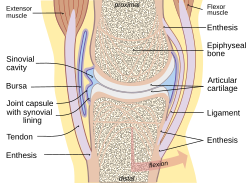 Typical joint | |
 Within the knee joint: bursae visible top right, middle right and bottom right | |
| Details | |
| Identifiers | |
| Latin | bursa synovialis |
| MeSH | D002061 |
| TA | A03.0.00.039 |
| TH | H3.03.00.0.00039 |
| FMA | 9692 |
Anatomical terminology [edit on Wikidata] | |
A synovial bursa (plural bursae or bursas) is a small fluid-filled sac lined by synovial membrane with an inner capillary layer of viscous synovial fluid (similar in consistency to that of a raw egg white). It provides a cushion between bones and tendons and/or muscles around a joint. This helps to reduce friction between the bones and allows free movement. Bursae are found around most major joints of the body.
Contents
1 Structure
2 Clinical significance
3 History
3.1 Etymology
4 See also
5 External links
Structure
There are four types of bursa: adventitious, subcutaneous, synovial, and sub-muscular. Among these, only adventitious is non-native. When any surface of the body is subjected to repeated stress, an adventitious bursa develops under it. Examples are Students' elbow and bunion.
Clinical significance
Infection or irritation of a bursa leads to bursitis (inflammation of a bursa). The general term for disease of bursae is "bursopathy."
History
Etymology
Bursa is Medieval Latin for "purse", so named for the resemblance of an anatomical bursa to a purse. Bursae or bursas is its plural form.
See also
Bursa of Fabricius (a lymphatic organ in birds)- Bursectomy
- Knee bursae
External links
 | Wikimedia Commons has media related to Synovial bursae. |
Imaging of the Bursae via Pub Med https://www.ncbi.nlm.nih.gov/pmc/articles/PMC3177464/
- Bursa
- Diagram of elbow with olecranon bursa

