Pascal's rule
In mathematics, Pascal's rule is a combinatorial identity about binomial coefficients. It states that for any natural number n we have
- (n−1k)+(n−1k−1)=(nk)for 1≤k≤n{displaystyle {n-1 choose k}+{n-1 choose k-1}={n choose k}quad {text{for }}1leq kleq n}

where (nk){displaystyle {n choose k}}
- (nk)+(nk−1)=(n+1k)for 1≤k≤n+1{displaystyle {n choose k}+{n choose k-1}={n+1 choose k}quad {text{for }}1leq kleq n+1}

Contents
1 Combinatorial proof
2 Algebraic proof
3 Generalization
4 See also
5 Sources
6 External links
Combinatorial proof
Pascal's rule has an intuitive combinatorial meaning. Recall that (ab){displaystyle {a choose b}}
Now, suppose you distinguish a particular element 'X' from the set with n elements. Thus, every time you choose k elements to form a subset there are two possibilities: X belongs to the chosen subset or not.
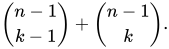
If X is in the subset, you only really need to choose k − 1 more objects (since it is known that X will be in the subset) out from the remaining n − 1 objects. This can be accomplished in (n−1k−1){displaystyle n-1 choose k-1}
When X is not in the subset, you need to choose all the k elements in the subset from the n − 1 objects that are not X. This can be done in (n−1k){displaystyle n-1 choose k}
We conclude that the numbers of ways to get a k-subset from the n-set, which we know is (nk){displaystyle {n choose k}}
(n−1k−1)+(n−1k).{displaystyle {n-1 choose k-1}+{n-1 choose k}.}
See also Bijective proof.
Algebraic proof
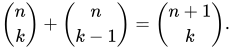
We need to show
- (nk)+(nk−1)=(n+1k).{displaystyle {n choose k}+{n choose k-1}={n+1 choose k}.}
- (nk)+(nk−1)=n!k!(n−k)!+n!(k−1)!(n−k+1)!=n![n−k+1k!(n−k+1)!+kk!(n−k+1)!]=n!(n+1)k!(n−k+1)!=(n+1k){displaystyle {begin{aligned}{n choose k}+{n choose k-1}&={frac {n!}{k!(n-k)!}}+{frac {n!}{(k-1)!(n-k+1)!}}\&=n!left[{frac {n-k+1}{k!(n-k+1)!}}+{frac {k}{k!(n-k+1)!}}right]\&={frac {n!(n+1)}{k!(n-k+1)!}}={binom {n+1}{k}}end{aligned}}}
![{displaystyle {begin{aligned}{n choose k}+{n choose k-1}&={frac {n!}{k!(n-k)!}}+{frac {n!}{(k-1)!(n-k+1)!}}\&=n!left[{frac {n-k+1}{k!(n-k+1)!}}+{frac {k}{k!(n-k+1)!}}right]\&={frac {n!(n+1)}{k!(n-k+1)!}}={binom {n+1}{k}}end{aligned}}}](https://wikimedia.org/api/rest_v1/media/math/render/svg/4cee6f328d957ef3016686da596a08b802e657f9)
Generalization
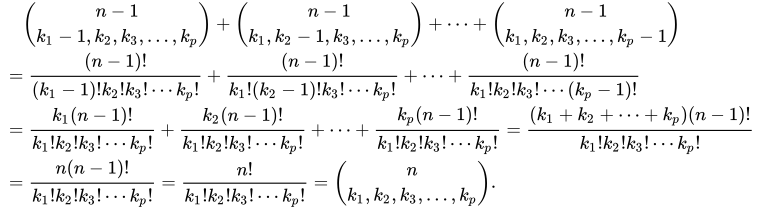
Let n,k1,k2,k3,…,kp,p∈N∗{displaystyle n,k_{1},k_{2},k_{3},dots ,k_{p},pin mathbb {N} ^{*}}

- (n−1k1−1,k2,k3,…,kp)+(n−1k1,k2−1,k3,…,kp)+⋯+(n−1k1,k2,k3,…,kp−1)=(n−1)!(k1−1)!k2!k3!⋯kp!+(n−1)!k1!(k2−1)!k3!⋯kp!+⋯+(n−1)!k1!k2!k3!⋯(kp−1)!=k1(n−1)!k1!k2!k3!⋯kp!+k2(n−1)!k1!k2!k3!⋯kp!+⋯+kp(n−1)!k1!k2!k3!⋯kp!=(k1+k2+⋯+kp)(n−1)!k1!k2!k3!⋯kp!=n(n−1)!k1!k2!k3!⋯kp!=n!k1!k2!k3!⋯kp!=(nk1,k2,k3,…,kp).{displaystyle {begin{aligned}&{}quad {n-1 choose k_{1}-1,k_{2},k_{3},dots ,k_{p}}+{n-1 choose k_{1},k_{2}-1,k_{3},dots ,k_{p}}+cdots +{n-1 choose k_{1},k_{2},k_{3},dots ,k_{p}-1}\&={frac {(n-1)!}{(k_{1}-1)!k_{2}!k_{3}!cdots k_{p}!}}+{frac {(n-1)!}{k_{1}!(k_{2}-1)!k_{3}!cdots k_{p}!}}+cdots +{frac {(n-1)!}{k_{1}!k_{2}!k_{3}!cdots (k_{p}-1)!}}\&={frac {k_{1}(n-1)!}{k_{1}!k_{2}!k_{3}!cdots k_{p}!}}+{frac {k_{2}(n-1)!}{k_{1}!k_{2}!k_{3}!cdots k_{p}!}}+cdots +{frac {k_{p}(n-1)!}{k_{1}!k_{2}!k_{3}!cdots k_{p}!}}={frac {(k_{1}+k_{2}+cdots +k_{p})(n-1)!}{k_{1}!k_{2}!k_{3}!cdots k_{p}!}}\&={frac {n(n-1)!}{k_{1}!k_{2}!k_{3}!cdots k_{p}!}}={frac {n!}{k_{1}!k_{2}!k_{3}!cdots k_{p}!}}={n choose k_{1},k_{2},k_{3},dots ,k_{p}}.end{aligned}}}
See also
- Pascal's triangle
Sources
- This article incorporates material from Pascal's rule on PlanetMath, which is licensed under the Creative Commons Attribution/Share-Alike License.
- This article incorporates material from Pascal's rule proof on PlanetMath, which is licensed under the Creative Commons Attribution/Share-Alike License.
- Merris, Russell. Combinatorics. John Wiley & Sons. 2003 .mw-parser-output cite.citation{font-style:inherit}.mw-parser-output q{quotes:"""""""'""'"}.mw-parser-output code.cs1-code{color:inherit;background:inherit;border:inherit;padding:inherit}.mw-parser-output .cs1-lock-free a{background:url("//upload.wikimedia.org/wikipedia/commons/thumb/6/65/Lock-green.svg/9px-Lock-green.svg.png")no-repeat;background-position:right .1em center}.mw-parser-output .cs1-lock-limited a,.mw-parser-output .cs1-lock-registration a{background:url("//upload.wikimedia.org/wikipedia/commons/thumb/d/d6/Lock-gray-alt-2.svg/9px-Lock-gray-alt-2.svg.png")no-repeat;background-position:right .1em center}.mw-parser-output .cs1-lock-subscription a{background:url("//upload.wikimedia.org/wikipedia/commons/thumb/a/aa/Lock-red-alt-2.svg/9px-Lock-red-alt-2.svg.png")no-repeat;background-position:right .1em center}.mw-parser-output .cs1-subscription,.mw-parser-output .cs1-registration{color:#555}.mw-parser-output .cs1-subscription span,.mw-parser-output .cs1-registration span{border-bottom:1px dotted;cursor:help}.mw-parser-output .cs1-hidden-error{display:none;font-size:100%}.mw-parser-output .cs1-visible-error{font-size:100%}.mw-parser-output .cs1-subscription,.mw-parser-output .cs1-registration,.mw-parser-output .cs1-format{font-size:95%}.mw-parser-output .cs1-kern-left,.mw-parser-output .cs1-kern-wl-left{padding-left:0.2em}.mw-parser-output .cs1-kern-right,.mw-parser-output .cs1-kern-wl-right{padding-right:0.2em}
ISBN 978-0-471-26296-1
External links
"Central binomial coefficient". PlanetMath.
"Binomial coefficient". PlanetMath.
"Pascal's triangle". PlanetMath.

