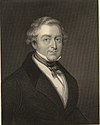
Alexander Baring, 1st Baron Ashburton
 | This article includes a list of references, but its sources remain unclear because it has insufficient inline citations. (March 2013) (Learn how and when to remove this template message) |
The Right Honourable The Lord Ashburton PC | |
|---|---|
 | |
| President of the Board of Trade | |
In office 15 December 1834 – 8 April 1835 | |
| Monarch | William IV |
| Prime Minister | Sir Robert Peel, Bt |
| Preceded by | Charles Poulett Thomson |
| Succeeded by | Charles Poulett Thomson |
| Master of the Mint | |
In office 23 December 1834 – 8 April 1835 | |
| Monarch | William IV |
| Prime Minister | Sir Robert Peel, Bt |
| Preceded by | Hon. James Abercromby |
| Succeeded by | Henry Labouchere |
| Personal details | |
| Born | 27 October 1774 (1774-10-27) |
| Died | 12 May 1848 (1848-05-13) (aged 73) Longleat, Wiltshire |
| Nationality | British |
| Political party | Tory |
| Spouse(s) | Anne Louisa Bingham (d. 1848) |
Alexander Baring, 1st Baron Ashburton PC (27 October 1774 – 12 May 1848) was a British politician and financier, and a member of the Baring family. Baring was the second son of Sir Francis Baring, 1st Baronet, and of Harriet, daughter of William Herring. His grandfather, John Baring (1697–1748), emigrated from Germany and established the family in England.
Contents
1 Business career
2 Political career
3 Family
4 Styles of address
5 Quotes
6 References
7 External links
Business career
Alexander was brought up in his father's business, and became a partner at Hope & Co. He was sent to the United States for various land deals, and formed wide connections with wealthy American families. In 1807 Alexander became a partner in the family firm, along with his brothers Thomas and Henry, and the name was changed to Baring Brothers & Co. When Henry Hope died in 1811, the London offices of Hope & Co. merged with Baring Brothers & Co.
Political career
Baring sat in parliament for Taunton between 1806 and 1826, for Callington between 1826 and 1831, for Thetford between 1831 and 1832 and North Essex between 1832 and 1835. He regarded politics from the point of view of the business man and opposed the orders-in-council for "the restrictions on trade with the United States in 1812," and, in 1826, the act for the suppression of small banknotes as well as other reform. He accepted the post Chancellor of the Exchequer in the Duke of Wellington's projected ministry of 1832; but afterwards, alarmed at the men in parliament, declared "he would face a thousand devils rather than such a House of Commons."[1] After the Panic of 1847, Baring headed an external bimetallist movement hoping to prevent the undue restriction of the currency.[2]
Baring was Master of the Mint in Robert Peel's government and, on Peel's retirement in 1835, was raised to the peerage as Baron Ashburton, of Ashburton, in the County of Devon,[3] a title previously held by John Dunning, 1st Baron Ashburton. In 1842 he was again sent to America, and the same year concluded the Webster-Ashburton Treaty. A compromise was settled concerning the north-east boundary of Maine, the extradition of certain criminals was arranged, each state agreed to maintain a squadron of at least eighty guns on the coast of Africa for the suppression of the slave trade, and the two governments agreed to unite in an effort to persuade other powers to close all slave markets within their territories. Despite his earlier attitude, Lord Ashburton disapproved of Peel's free trade and opposed the Bank Charter Act of 1844.[1]
Ashburton was a trustee of the British Museum and of the National Gallery, a privy councillor and D.C.L. He published, besides several speeches, An Enquiry into the Causes and Consequences of ... Orders in Council (1808), and The Financial and Commercial Crisis Considered (1847).[1]
Family
Ashburton married Anne Louisa, daughter of the American statesman William Bingham, of Philadelphia, on 23 August 1798. They had nine children:
Bingham Baring, 2nd Baron Ashburton (1799–1864)
Francis Baring, 3rd Baron Ashburton (1800–1868)- Hon. Harriet Baring (3 May 1804 – 2 January 1892), married Henry Thynne, 3rd Marquess of Bath
- Hon. Rev. Frederick Baring (31 January 1806 – 4 June 1868), married on 24 April 1831 Frederica Ashton and had issue
- Hon. Anne Eugenia Baring (died 8 March 1839), married Humphrey St John-Mildmay
- Alexander Baring (2 May 1810 – 12 March 1832)
- Hon. Arthur Baring (8 October 1818 – 16 February 1838)
- Hon. Louisa Emily Baring (died 23 March 1888)
- Hon. Lydia Emily Baring (died 28 December 1868)
Styles of address
- 1774–1806: Mr Alexander Baring
- 1806–1834: Mr Alexander Baring MP
- 1834–1835: The Right Honourable Alexander Baring MP
- 1835–1848: The Right Honourable The Lord Ashburton PC
Quotes
Of this great mercantile family the Duc de Richelieu wittily remarked; "There are six main powers in Europe; Britain, France, Austria-Hungary, Russia, Prussia and Baring-Brothers!"
(Vicary Gibbs, from the "Complete Peerage" 1910).
References
^ abc Chisholm 1911.
^ É. Halévy (1961) Victorian Years. London: Ernest Benn; p. 201
^ "No. 19257". The London Gazette. 10 April 1835. p. 699..mw-parser-output cite.citation{font-style:inherit}.mw-parser-output .citation q{quotes:"""""""'""'"}.mw-parser-output .citation .cs1-lock-free a{background:url("//upload.wikimedia.org/wikipedia/commons/thumb/6/65/Lock-green.svg/9px-Lock-green.svg.png")no-repeat;background-position:right .1em center}.mw-parser-output .citation .cs1-lock-limited a,.mw-parser-output .citation .cs1-lock-registration a{background:url("//upload.wikimedia.org/wikipedia/commons/thumb/d/d6/Lock-gray-alt-2.svg/9px-Lock-gray-alt-2.svg.png")no-repeat;background-position:right .1em center}.mw-parser-output .citation .cs1-lock-subscription a{background:url("//upload.wikimedia.org/wikipedia/commons/thumb/a/aa/Lock-red-alt-2.svg/9px-Lock-red-alt-2.svg.png")no-repeat;background-position:right .1em center}.mw-parser-output .cs1-subscription,.mw-parser-output .cs1-registration{color:#555}.mw-parser-output .cs1-subscription span,.mw-parser-output .cs1-registration span{border-bottom:1px dotted;cursor:help}.mw-parser-output .cs1-ws-icon a{background:url("//upload.wikimedia.org/wikipedia/commons/thumb/4/4c/Wikisource-logo.svg/12px-Wikisource-logo.svg.png")no-repeat;background-position:right .1em center}.mw-parser-output code.cs1-code{color:inherit;background:inherit;border:inherit;padding:inherit}.mw-parser-output .cs1-hidden-error{display:none;font-size:100%}.mw-parser-output .cs1-visible-error{font-size:100%}.mw-parser-output .cs1-maint{display:none;color:#33aa33;margin-left:0.3em}.mw-parser-output .cs1-subscription,.mw-parser-output .cs1-registration,.mw-parser-output .cs1-format{font-size:95%}.mw-parser-output .cs1-kern-left,.mw-parser-output .cs1-kern-wl-left{padding-left:0.2em}.mw-parser-output .cs1-kern-right,.mw-parser-output .cs1-kern-wl-right{padding-right:0.2em}
Attribution:
"Baring pedigree". Archived from the original on 5 January 2007. Retrieved 2007-01-22.
 This article incorporates text from a publication now in the public domain: Chisholm, Hugh, ed. (1911). . Encyclopædia Britannica. 2 (11th ed.). Cambridge University Press. pp. 729–730.
 This article incorporates text from a publication now in the public domain: Chisholm, Hugh, ed. (1911).
External links
- Hansard 1803–2005: contributions in Parliament by Alexander Baring
Parliament of the United Kingdom | ||
|---|---|---|
| Preceded by William Morland John Hammet | Member of Parliament for Taunton 1806–1826 With: John Hammet 1806–1811 Henry Powell Collins 1812–1818, 1819–1820 Sir William Burroughs, Bt 1818–1819 John Ashley Warre 1820–1826 | Succeeded by Henry Seymour William Peachey |
| Preceded by Matthias Attwood William Thompson | Member of Parliament for Callington 1826–1831 With: Matthias Attwood 1826–1830 Bingham Baring 1830–1831 | Succeeded by Henry Bingham Baring Edward Charles Hugh Herbert |
| Preceded by Lord James FitzRoy Francis Baring | Member of Parliament for Thetford 1831–1832 With: Lord James FitzRoy | Succeeded by Lord James FitzRoy Francis Baring |
New constituency | Member of Parliament for North Essex 1832–1835 With: Sir John Tyrell, Bt | Succeeded by Sir John Tyrell, Bt John Payne Elwes |
| Political offices | ||
| Preceded by Charles Poulett Thomson | President of the Board of Trade 1834–1835 | Succeeded by Charles Poulett Thomson |
| Preceded by James Abercromby | Master of the Mint 1834–1835 | Succeeded by Henry Labouchere |
Peerage of the United Kingdom | ||
| Preceded by New Creation | Baron Ashburton 1835–1848 | Succeeded by Bingham Baring |
Cabinet of Prime Minister Sir Robert Peel (1834–1835) | ||
|---|---|---|
Prime Minister of the United Kingdom Leader of the House of Commons Chancellor of the Exchequer |
|  |
| Lord Chancellor |
| |
| Lord President of the Council |
| |
Foreign Secretary Leader of the House of Lords |
| |
| Home Secretary |
| |
| First Lord of the Admiralty |
| |
| Lord Privy Seal |
| |
| Secretary of State for War and the Colonies |
| |
| Master-General of the Ordnance |
| |
President of the Board of Trade Master of the Mint |
| |
| President of the Board of Control |
| |
| Paymaster of the Forces |
| |
| Secretary at War |
| |
Authority control  |
|
|---|


